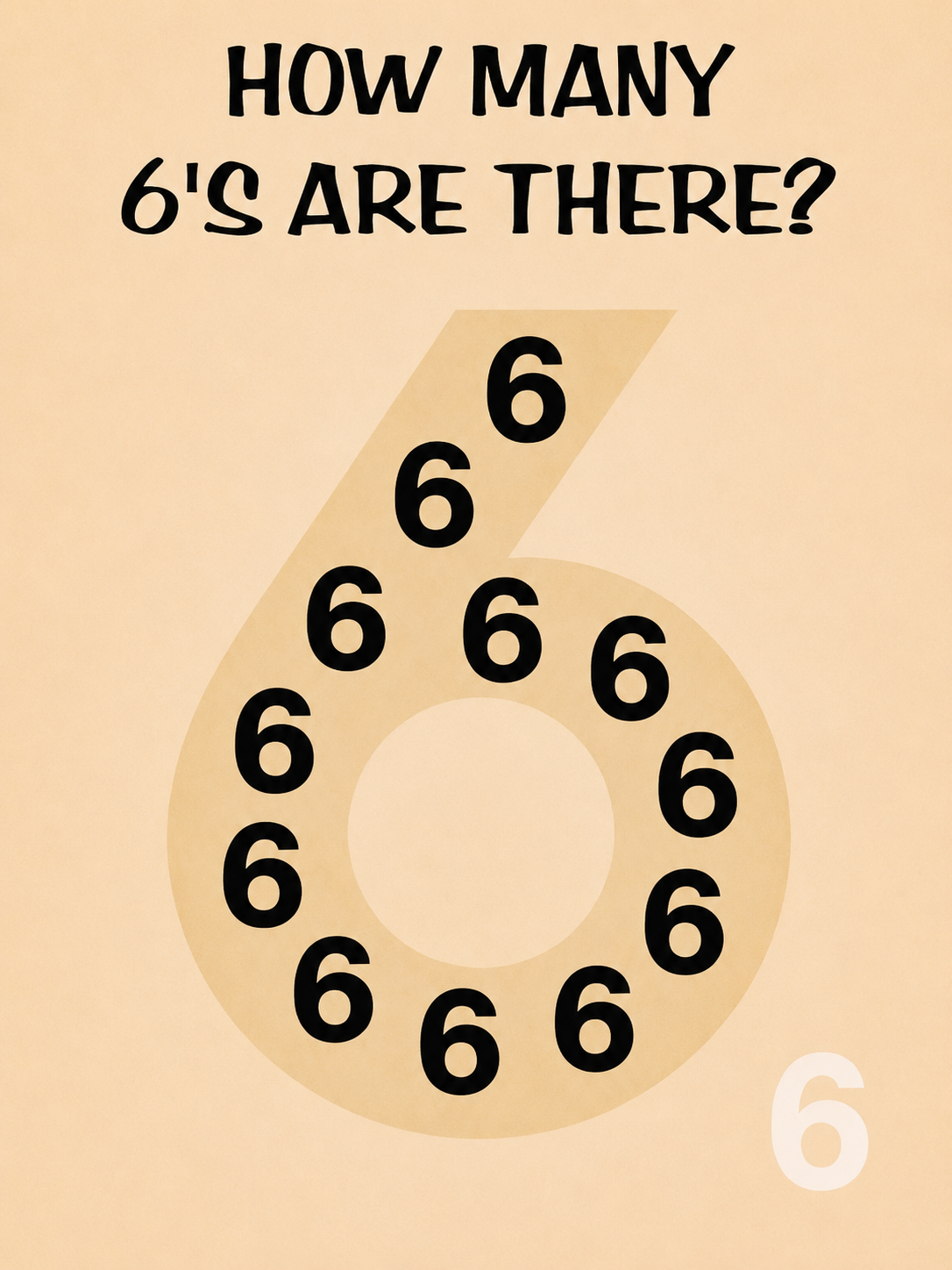
How Many 6’s Are There? The Answer Is More Than You Think
At first glance, this puzzle looks incredibly simple. It asks a straightforward question:
“How many 6’s are there?”
Most people immediately begin counting only the small black number 6s inside the large beige number. Because the puzzle appears easy, many people answer quickly without carefully examining every part of the image. That’s exactly what makes it such an effective brain teaser.
The secret isn’t hidden in difficult mathematics or complex logic. Instead, it’s a test of observation, attention to detail, and the tendency of the human brain to make assumptions.
Step 1: Count the small black 6s
Inside the large beige number 6 are several smaller black number 6s.
If you carefully count them from top to bottom, you’ll find there are 12 small black sixes.
Many people stop here and confidently say the answer is 12.
Unfortunately, that isn’t the complete answer.
Step 2: Notice the large background 6
The smaller numbers are arranged inside a much larger beige-colored number 6 that forms the main shape of the picture.
Although it’s lighter than the black numbers, it is still clearly a number 6.
Now your total becomes:
- 12 small sixes
- 1 large six
Total: 13
Many people think they’ve solved it at this point.
But the puzzle still isn’t finished.
Step 3: Read the question carefully
At the top, the title says:
“HOW MANY 6’S ARE THERE?”
Notice something?
The question itself contains another 6 in the phrase:
“6’S”
That is another visible number six.
Now the count becomes:
- 12 small sixes
- 1 large beige six
- 1 six in the title
Running total: 14
But wait…
There’s one more.
Step 4: Look in the bottom-right corner
In the lower-right corner of the image is a faded white number 6.
Because it blends into the background, many people overlook it completely.
Add this final six.
Now the total is:
- 12 small black sixes
- 1 large beige six
- 1 six in the title
- 1 faded white six in the corner
Grand Total: 15
Final Answer
There are 15 number 6s in the image.
Why do so many people get this wrong?
This puzzle isn’t really testing your ability to count. It’s testing how your brain processes visual information.
Psychologists know that when people are given a task, their brains naturally filter out information they believe is unimportant. This phenomenon is known as selective attention. Once your brain decides that the goal is to count the black numbers inside the shape, it begins ignoring everything else.
That’s why many people completely miss:
- the giant background 6,
- the 6 in the title,
- and the faded 6 in the corner.
Your eyes actually see them, but your brain doesn’t treat them as relevant because it has already formed a mental shortcut.
Another cognitive effect involved is called confirmation bias. Once someone counts twelve small sixes, they often stop searching because they’ve found an answer that seems reasonable. Instead of checking the entire image again, they look only for evidence that supports their first conclusion.
This puzzle also demonstrates a principle known as inattentional blindness, where obvious objects can go unnoticed simply because your attention is focused elsewhere. Famous psychology experiments have shown that people can completely miss a person in a gorilla suit walking through a basketball game when they are concentrating on counting passes. Similarly, this puzzle hides additional sixes in plain sight because your attention is directed toward only one part of the image.
Brain teasers like this are popular because they reward careful observation rather than speed. In everyday life, people often rush through tasks, skim documents, or make decisions based on first impressions. This puzzle reminds us that taking a few extra seconds to examine all the details can completely change the outcome.
So the next time you encounter a seemingly simple puzzle, remember that the first answer isn’t always the complete one. Slow down, scan the entire image, and question your initial assumptions. Often, the real challenge isn’t counting correctly—it’s noticing everything that deserves to be counted.
Correct Answer: 15 ✅