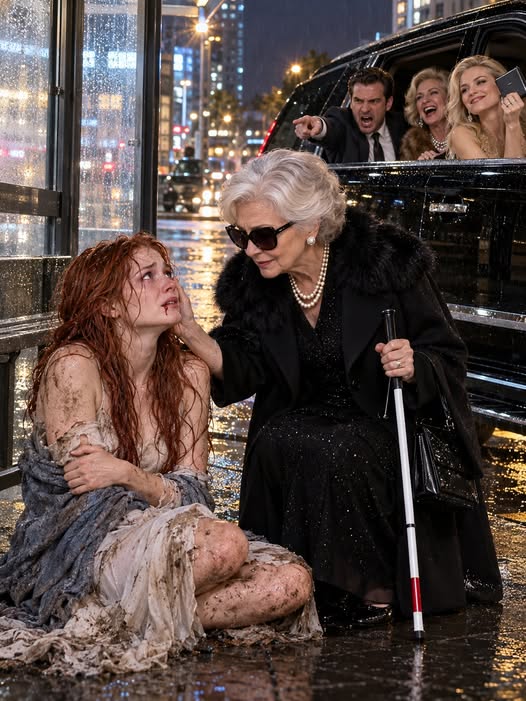
After My Husband Left Me Stranded at a Bus Stop in the Rain With No Money to “Teach Me a Lesson,” a Blind Elderly Woman Told Me, “Act Like You’re My Granddaughter. My Driver Is on His Way. Your Husband Is Going to Regret Abandoning You Here… I’m the Wealthiest Woman in This City.”
PART 1

My husband left me at a bus stop in the pouring rain with no purse, no phone, and dried blood still cracking on my lip. Then he rolled down the window of his shiny black Cadillac and smiled like my suffering was his favorite private joke.
“Walk home, Evelyn,” Donald said through the cracked window. “Maybe by tomorrow morning you will finally learn how to show some real gratitude.”
His mother, Constance, sat in the passenger seat wearing her expensive silk scarf, laughing softly under her breath. In the back seat, his administrative assistant, Brenda, leaned forward and waved my pink leather wallet between two bright red manicured fingers.
“You do not need money tonight, sweetie,” Brenda sneered with a smug grin. “What you actually need is some proper discipline.”
The luxury sedan accelerated into the darkness, splashing muddy street water all over my knees before vanishing into the heavy storm.
For a whole minute, I stood beneath the flickering neon bulb of the bus shelter and watched my reflection tremble in a dark puddle. My knees were shaking uncontrollably, but it was not from fear, because it was pure restraint.
Donald genuinely believed I was still the quiet, obedient wife he had spent five years training to apologize for his volatile temper, his growing gambling debts, his endless affairs, and his mother’s sharp insults during family dinners. He believed that because I had stopped arguing back, I had completely stopped thinking for myself.
He was terribly wrong about that.
Three months before this night, I had discovered the first forged bank loan paper sitting inside the brass safe in his home office. After that, I uncovered three hidden shell corporations, followed by unauthorized wire transfers moving money out of my late father’s family trust into Donald’s failing real estate firm. I had spent weeks copying every single document, sending sealed files directly to my personal attorney, and patiently waiting for the right moment to strike.
I had only agreed to get into his car tonight because he swore we were going to an elegant business dinner with major city investors. Instead, he drove forty miles out to the edge of town, accused me of spying on his private accounts, slapped my face hard when I refused to hand over my phone password, and threw me out into the dark like a piece of trash.
A city bus hissed loudly as it sped past the shelter without slowing down for a second.
“My dear child,” a calm voice suddenly called out from the dark bench behind me, sounding as clear as church bells on a Sunday morning. “Is the cruel man who just drove off the same Donald Aldrich who owes money to half the prominent business families in this state?”
I turned around quickly, wiping my wet cheeks with the back of my hand.
An elderly woman was sitting on the wooden bench, wrapped snugly in a long cream wool coat with her pure white hair pinned into a neat bun. Dark sunglasses covered her eyes, and a thin white cane rested horizontally across her knees.
“I am so sorry to startle you,” I whispered back, taking a small step toward her. “I honestly did not realize anyone else was sitting back here.”
“I know you did not,” the old woman replied with a faint nod of her head. “Most people tend to look right past an old lady.”
She tilted her face toward the empty asphalt road where Donald’s tail lights had disappeared moments ago.
“Pretend you are my granddaughter right now,” she told me with absolute certainty. “My personal driver is coming to pick me up, and I promise you that your husband will regret the exact minute he decided to abandon you out here.”
I stood there staring at her lined face in complete silence.
Her lips curved into a small, confident smile that carried a sudden sharp edge.
“My name is Gertrude Harrington,” she stated calmly. “And I happen to be the wealthiest woman living in this entire city.”
PART 2
For several long moments, the only sound in the dark was the steady rain drumming against the tin roof above us.
I did not laugh at her claim, even though a part of my mind thought it sounded completely absurd. A blind elderly woman sitting alone at a remote bus stop late at night, claiming to own half the city, sounded like a strange fantasy.
However, I had just watched my own husband drive away with my money, my phone, and five years of my trust, so my perception of reality was already completely shattered.
“Mrs. Harrington,” I said slowly, stepping closer to her bench. “I am having a very hard time understanding what is happening right now.”
“You do not need to understand every detail just yet,” she answered warmly while tapping the wooden seat beside her. “Sit down next to me, child, because you are trembling so violently that I can hear your teeth chattering from here.”
I took a seat on the cold wood, shivering from the damp chill in the air. She immediately unbuttoned her heavy wool coat, sliding half of the warm fabric over my dripping shoulders as if she had looked after me her whole life. The thick fabric smelled faintly of lavender dried flowers and old paper.
“How did you know my husband’s name back there?” I asked her, pulling the coat closer around my chest. “Did you hear him shouting at me?”
“I heard his loud voice very clearly,” Gertrude explained, turning her head slightly toward the misty street. “When an arrogant man screams at a helpless woman in a deserted spot, the sound carries for miles across the open air. Besides, a car engine with a loose fan belt makes a very specific high squeal when turning a sharp corner, which tells me he neglects his vehicle maintenance just as much as he neglects his financial debts.”
“Do you actually know Donald personally?” I inquired, wiping a drop of rainwater from my chin.
“I do not know him face to face, but I certainly know his legal paperwork,” Gertrude said, folding her gloved hands over the brass handle of her white cane. “Just last Tuesday afternoon, my investment firm purchased a massive package of defaulted commercial loans directly from the state bank. Over twelve million dollars of bad debt was in that folder, and a huge chunk of it belongs to Donald’s property firm.”
My heart gave a sudden hard thud inside my chest.
“Your foolish husband has no idea yet,” Gertrude added with a calm smile. “As of three days ago, his entire company answers to me.”
A sleek dark gray town car glided up to the curb eight minutes later without making a single sound. A tall man in a black raincoat quickly stepped out into the downpour, holding a massive black umbrella open above his head.
“Mrs. Harrington,” the driver said in a low tone filled with visible relief. “You explicitly told me to return at ten o’clock, but it is already past ten forty now, so I have been driving around the block in circles for half an hour.”
“I was occupied with an important matter, Thomas,” she responded briskly.
The driver turned his attention toward me, his sharp eyes taking in my swollen lip, my drenched clothing, and my bare, shivering arms. His calm face hardened into a serious expression in an instant.
“Ma’am,” Thomas asked me with deep concern. “Are you hurt?”
Before I could form a proper sentence, Gertrude reached out her hand and found my wrist on her very first try.
“Thomas, this young lady is my granddaughter,” Gertrude announced firmly. “She has had an awful evening, so we are taking her back to the estate immediately.”
Thomas had clearly worked for her for decades, because he did not ask a single question or express any doubt. He simply adjusted the large umbrella to cover both of us, walked us to the passenger door, and opened it wide.
The inside of the vehicle was beautifully heated and smelled of fresh leather. A folded cashmere blanket was waiting on the soft back seat, along with a warm thermos of tea resting in the central console. Gertrude settled into her seat, letting out a deep sigh as the heavy doors shut out the howling wind.
“Why were you sitting out at that lonely bus stop all by yourself in a storm?” I asked as the car accelerated smoothly onto the empty highway.
Gertrude remained silent for a few moments, watching the raindrops streak across the illuminated glass windows.
“Forty years ago, I was a broke twenty-one year old girl with only six dollars left in my pocket,” she began softly. “I got off a regional transport bus at that exact stop because I did not have enough coins to pay for a ticket into the city center. I sat on that exact bench and sobbed my eyes out, until a young mechanic wearing a grease-stained uniform sat next to me and offered to share his ham sandwich.”
A tender smile spread across her face as she remembered the past.
“His name was Samuel Harrington, and we spent forty wonderful years building a life together before he passed away,” she shared softly. “Every autumn, I insist on returning to that wooden bench to sit quietly for an hour, because it is the one place where I can still feel young and full of hope.”
My throat felt tight, and I found myself unable to speak a single word.
“So when I sat there tonight listening to a cruel coward demand that his wife walk home in a freezing rainstorm, my blood boiled,” Gertrude continued with a firm set to her jaw. “I may have lost my eyesight to medical complications ten years ago, but I have never needed working eyes to spot a bully.”
The Harrington property sat high on a private hill overlooking the winding river, secured behind giant wrought iron gates and a long driveway lined with massive oak trees. I had passed those outer gates dozens of times over the years without ever seeing the main structure hidden behind the foliage.
The house was a stately stone mansion with warm yellow light pouring from every window. As soon as Thomas unlocked the heavy front door, an elderly woman in a woolen sweater came hurrying down the hallway carrying a stack of dry towels.
“Gertrude, you promised me faithfully that you would be back home by nine thirty,” the woman scolded gently before stopping dead in her tracks. “Oh goodness me, look at this poor girl.”
“Martha, this is Evelyn,” Gertrude introduced me as she removed her wet gloves. “Please prepare a hot bath and dry clothes for her right away, and call Dr. Miller to come over immediately.”
“It is nearly eleven o’clock at night,” Martha pointed out with wide eyes.
“Dr. Miller owes his entire medical career to my scholarship fund,” Gertrude countered calmly. “He will happily drive over here tonight.”
Martha was the head housekeeper who had lived on the estate for over thirty years, treating Gertrude more like an older sister than an employer. She led me upstairs to a spacious guest room where a log fire was already crackling in the hearth, leaving me a thick knit sweater and soft cotton trousers.
I sat on the rim of the large porcelain tub, watching the hot steam rise toward the ceiling.
That was the moment I finally let go and wept uncontrollably.
It was not the silent, polite crying I had forced myself to practice during awkward family gatherings when my mother-in-law insulted my appearance or when Donald belittled my intelligence in front of his wealthy colleagues. It was raw, heavy weeping that pulled from deep inside my chest and shook my whole body.
I cried for the naive girl who had married Donald five years ago, believing his grand promises of protection and love. I cried for my late father, who had shaken Donald’s hand at our wedding reception while trusting him to treat me right. I cried for every single instance where I had apologized for mistakes I never committed just to keep the peace.
When I finally walked back downstairs forty minutes later, my eyes were swollen red, but my trembling hands had grown completely still.
Dr. Miller was a kind man with silver hair who examined the cut on my lip and the deep bruise forming along my cheekbone under a bright desk lamp in the library. He carefully snapped several clear photographs with his camera and made detailed notes inside a black notebook.
“I am writing down every visible mark,” the doctor explained in a gentle tone. “If you decide to take this matter to the authorities, these documented medical facts will prove crucial in court.”
“I am definitely pressing criminal charges against him,” I stated firmly without hesitation.
The doctor looked up from his notes and gave me an approving nod.
“I have been gathering financial evidence against Donald for three long months,” I continued, sitting down near the hearth. “I just did not expect him to escalate to physical violence tonight.”
Gertrude sat in a high-backed armchair across from me, holding a cup of tea in her lap, turning her head toward the sound of my voice.
“Tell me everything about his actions,” Gertrude requested gently. “Start from the very beginning.”
I took a deep breath and laid out the entire history.
I told her about my father, Arthur Ross, who had owned a chain of hardware supply stores that he built through decades of relentless hard work. When he passed away three years ago from a sudden heart condition, he left me a family trust valued at over five million dollars, specifically intended to give me long-term financial security.
I described how Donald stepped in right after the funeral, insisting on managing the accounts because I was overwhelmed with grief. I confessed that I had foolishly signed several financial authorization forms without reading the fine print because I trusted my husband completely.
I detailed the quiet evening in July when Donald was out of town, and I went into his private study to find our passports for a vacation. The brass safe was unlocked, and inside I discovered a massive bank loan application bearing my full signature at the bottom.
“I knew my own signature inside out,” I explained, leaning forward. “The person who forged it did a convincing job, but they made the letter E with a small top loop, which is the exact way Donald writes his own letters.”
From that moment on, I began investigating everything behind his back. I memorized his master computer password, copied transaction logs late at night while he slept, and uncovered three fake holding companies registered under generic corporate names. Over four million dollars had been secretly siphoned out of my father’s trust and funneled directly into Donald’s failing business ventures.
“He drained my father’s hard-earned money to pay off his own commercial debts,” I said softly. “And when that fund ran completely dry, he took out massive unauthorized loans using my name as the sole guarantor.”
Gertrude’s fingers tightened around her teacup until her knuckles turned white.
“Does anyone else possess these documents?” she inquired sharply.
“My personal attorney, Sarah Lawson, holds full copies of every paper,” I answered promptly. “We were preparing to file for a legal separation next month while simultaneously freezing the trust accounts. Donald must have suspected something was wrong tonight, because he suddenly accused me of spying on him right before he grabbed my phone.”
I paused, touching the sore mark on my jawline.
Gertrude set her teacup down on the saucer with a deliberate click.
“Your father,” Gertrude said slowly, a look of realization dawning on her face. “Was his name Arthur Ross? The man who ran Ross Hardware on Main Street?”
I looked at her in surprise. “Yes, that was him. Did you know my father?”
For the first time all evening, Gertrude’s immaculate composure wavered. She placed her trembling hand flat against her chest and took a long, unsteady breath.
“Back in the winter of 1982,” Gertrude revealed softly, her voice filled with emotion, “my husband and I were struggling to keep our small manufacturing shop open during a terrible economic slump. The regional banks refused to grant us a credit extension, and our material suppliers were threatening legal action. Your father was a young merchant back then, and he gave us six months of interest-free credit on a massive order of tools.”
She paused, taking a moment to regain her composure as the fireplace crackled beside us.
“When I tried to express my gratitude to him,” Gertrude continued, her eyes glistening with tears, “your father looked me in the eye and said, ‘Mrs. Harrington, someday someone else will need you to stand by them when things get dark, so just pass the favor along when the time comes.’”
The library fell completely silent.
“That tiny machine shop grew into Harrington Global,” Gertrude added with deep respect. “I sent your father a personal holiday letter every single year until he passed away, and he never once asked me for a single favor in return.”
I sat in my chair, completely overwhelmed by the revelation.
Gertrude reached across the small table, and I placed my fingers firmly inside her warm grip.
“So you see, Evelyn,” the old woman said softly. “I am not doing you a random favor tonight. I am simply settling a forty-year-old debt to your wonderful father.”
My attorney, Sarah Lawson, arrived at the estate at seven o’clock the following morning carrying a bulky leather briefcase packed with files. She pulled me into a fierce hug the moment she stepped through the front door.