He Got Stuck in a Hole Barely Bigger Than His Body, What Happened Inside That Space Will Stay With You
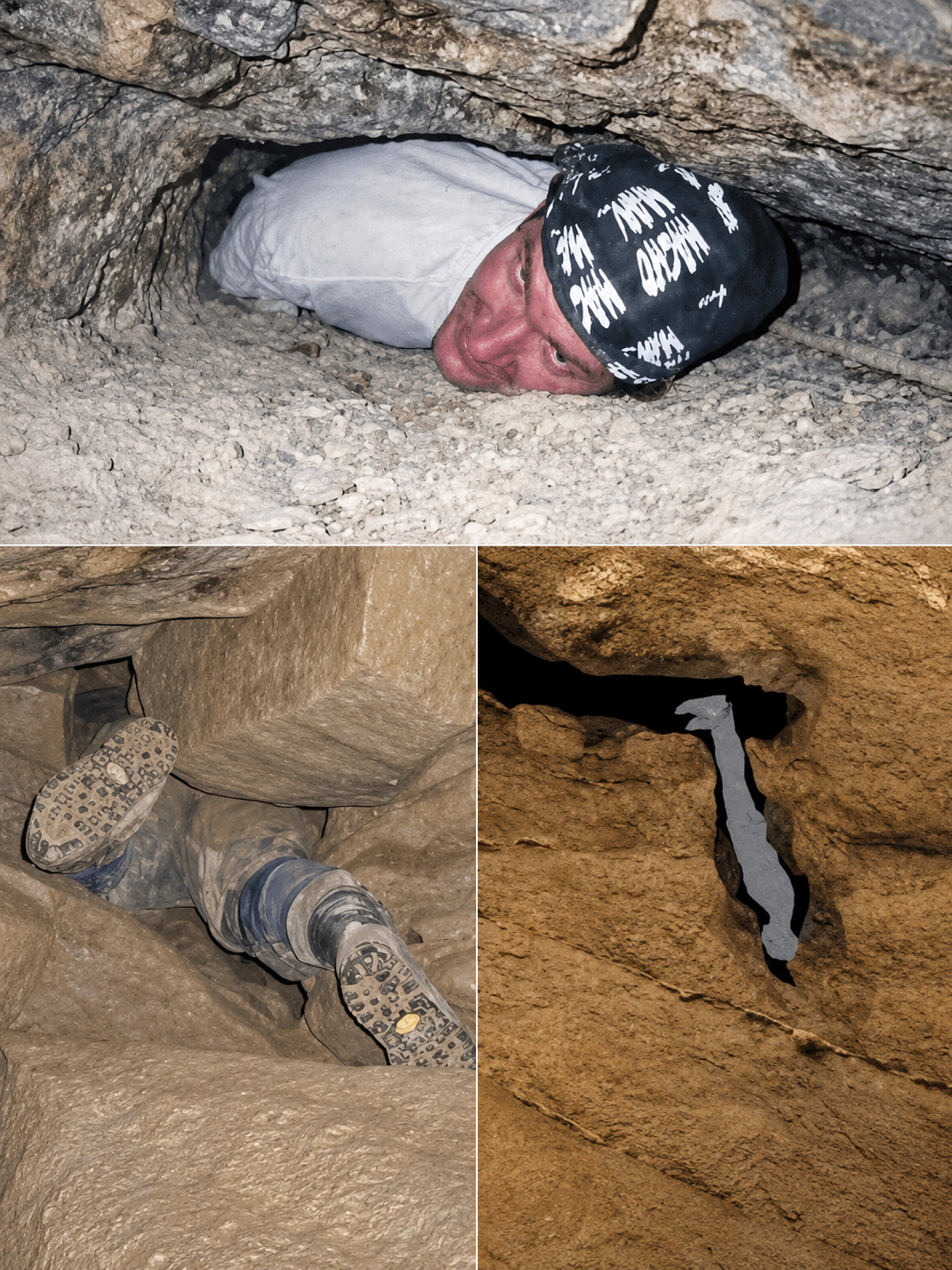
the death of John Edward Jones inside Nutty Putty Cave in Utah, United States, in November 2009. While the collage itself does not prove the identity of the individual, it closely resembles widely published images and illustrations used to explain the narrow passage where Jones became trapped. Combined with the accompanying story, the image represents the extreme dangers of cave exploration and the limits of even the largest rescue efforts.
At first glance, the collage conveys an overwhelming sense of confinement. The top photograph shows a man wedged head-first inside a limestone passage so narrow that only his face and part of his shoulders are visible. The rock presses tightly against his body, leaving almost no room to move. There is no visible exit, no open chamber, and almost no indication of how rescuers could even reach him. This composition immediately evokes feelings of claustrophobia and helplessness.
The lower-left image provides a broader perspective of the passage. It shows the explorer’s legs and boots extending into a narrow tunnel whose dimensions are barely larger than the human body. Experienced cavers refer to passages like this as restrictions—sections where movement requires careful body positioning, controlled breathing, and often a precise sequence of motions. In many caves, restrictions are routine challenges, but when a passage narrows unexpectedly or slopes downward, they can become life-threatening.
The lower-right image appears to illustrate the position of the body inside the rock formation. Although simple, it helps viewers understand why the situation became so dangerous. Once the explorer’s body passed a certain point, there was insufficient room to reverse direction or generate enough leverage to push backward.
According to well-documented reports, John Edward Jones entered Nutty Putty Cave on 24 November 2009 with family members during a Thanksgiving visit. Jones had previously visited the cave years earlier, but the cave’s layout had changed due to closures and shifting conditions. Believing he was entering a known passage called the Birth Canal, he instead crawled into an unmapped or incorrectly identified fissure that gradually narrowed until it became impossible to continue or retreat.
Jones became trapped head-first, with his body angled downward. This position created multiple medical emergencies simultaneously. Gravity caused blood to pool in the upper part of his body, increasing pressure on his heart, lungs, and brain. Breathing became progressively more difficult because the diaphragm had to work against both gravity and the compression of the surrounding rock. Remaining inverted for many hours placed enormous strain on his cardiovascular system.
More than one hundred rescuers, including cave rescue specialists, firefighters, engineers, and medical personnel, participated in the rescue operation. Working inside such a confined environment was extraordinarily difficult. Equipment had to be carried through twisting passages only inches wider than a person. Rescuers installed ropes, anchors, and pulley systems in an attempt to pull Jones backward without causing additional injuries.
One of the most dramatic moments occurred when rescuers succeeded in moving him several feet. Unfortunately, an anchor point failed under the immense load. The rope system suddenly released, causing Jones to slide back into the same position from which rescuers had nearly freed him. This setback significantly reduced the chances of a successful rescue.
As time passed, Jones remained trapped upside down for nearly 28 hours. Medical experts have explained that prolonged inversion severely compromises circulation and organ function. Despite the rescuers’ efforts to provide fluids, oxygen, and communication, his condition steadily deteriorated. Eventually, he suffered cardiac arrest and could not be revived.
Following extensive evaluation, officials determined that recovering his body would expose rescuers to unacceptable risks. The passage remained extremely unstable, and another rescue attempt could have resulted in additional fatalities. Consequently, Nutty Putty Cave was permanently sealed, with John Edward Jones remaining inside. The cave effectively became both his final resting place and a memorial to the tragedy.
Beyond documenting a single accident, this image symbolizes the delicate balance between adventure and risk. Cave exploration offers opportunities to study unique geological formations and experience environments few people ever see, but it also presents hazards that can escalate rapidly. Darkness, confined spaces, complex navigation, limited communication, and difficult rescue conditions mean that even experienced explorers can encounter situations from which escape is impossible.
Ultimately, the image is powerful not because it shows dramatic action, but because it captures a moment of complete vulnerability. The narrow walls surrounding the explorer remind viewers how quickly confidence can become danger when nature leaves no room for error. The story of John Edward Jones continues to be remembered not only as a tragedy but also as a lasting lesson about preparation, risk assessment, and the extraordinary dedication of rescuers who worked tirelessly under nearly impossible conditions in an effort to save a life.