ICU Nurse Donates Part of Her Liver to Save an 8-Year-Old Boy After His Family Cannot Find a Matching Donor
An intensive care unit nurse in Wisconsin donated part of her own liver to save the life of an eight-year-old boy in 2019 after his family struggled to find a compatible donor. The operation was successful, and the two later developed a special bond that brought renewed attention to the importance of living organ donation.
The story involved Cami Loritz, a nurse working in the transplant intensive care unit at Froedtert Hospital in Milwaukee, and Brayden Auten, a young boy from Wrightstown, Wisconsin. Their experience demonstrated how a stranger’s decision to become a living donor can make a life-changing difference for another family.
A sudden illness changed a young boy’s life
In April 2019, Brayden appeared to be an ordinary, healthy child. However, his condition changed unexpectedly when he began experiencing stomach pain and diarrhea.
According to ABC News, Brayden became sick on April 25. His parents, James and Ruth Auten, initially thought he might have a common illness, such as the flu.
But they soon noticed something more concerning. His eyes began turning yellow, followed by yellowing of his skin. Recognizing that something was seriously wrong, his parents sought medical attention.
Brayden was admitted to Children’s Hospital of Milwaukee on April 26. Following medical examinations and an ultrasound, doctors discovered that his liver was not functioning properly.
His condition continued to deteriorate, and the medical team eventually determined that his liver had stopped working.
For his parents, the news was devastating. Their young son, who had previously enjoyed an active childhood, suddenly faced a life-threatening medical emergency.
Doctors explained that Brayden urgently needed a liver transplant. Finding a suitable donor became the family’s most important priority.
The difficult search for a compatible donor
After learning about the transplant requirement, the Auten family began searching for someone who could donate part of a liver.
Relatives and friends were considered as potential donors, but none of the people tested was found to be a suitable match.
The situation became increasingly frightening because Brayden needed treatment quickly.
His family also shared his story to raise awareness and reach people who might be able to help. Their appeal attracted attention and support from members of the community.
However, finding a compatible donor remained a significant challenge.
At that point, an unexpected person learned about the boy’s situation.
Cami Loritz, who worked in the transplant intensive care unit at Froedtert Hospital in Milwaukee, heard about Brayden’s urgent need for a liver transplant.
Rather than simply watching the family struggle, she decided to explore whether she could become a living donor.
A nurse makes an extraordinary decision
Loritz was familiar with organ transplantation through her professional work. She understood the seriousness of the situation and knew that a successful transplant could give Brayden an opportunity to recover.
She volunteered to become a living liver donor.
After undergoing the necessary medical assessments, Loritz was found to be compatible with Brayden.
The news provided the family with a new possibility at a time when they urgently needed hope.
Loritz did not know Brayden personally before learning about his situation. Nevertheless, she was willing to undergo a major operation to help a child she had never met.
In an interview reported by ABC News, Loritz explained her decision in simple terms, saying she had no reason not to go through with it.
Her decision was particularly meaningful because living liver donation involves surgery and medical risks for the healthy donor as well as the transplant recipient.
The procedure requires careful screening and evaluation to determine whether donating part of the liver is medically appropriate.
Two operations on the same day
On May 14, 2019, the transplant operations took place.
Loritz underwent surgery at Froedtert Hospital, while Brayden received his transplant at Children’s Hospital of Milwaukee.
Part of Loritz’s liver was donated for the young recipient.
The operations were successful, giving Brayden an opportunity to recover after the frightening medical emergency.
The two patients faced separate recovery journeys, but their lives had become connected through the transplant.
For the Auten family, the successful operation represented a turning point after weeks of uncertainty and fear.
Instead of continuing to search desperately for a donor, they could begin concentrating on their son’s recovery.
A special reunion after the transplant
Approximately two weeks after the surgeries, the hospital arranged an opportunity for Loritz and Brayden to meet.
Before that meeting, they had been connected through the transplant process without having a personal relationship.
Their first encounter became an emotional moment for both sides.
Brayden was initially nervous and did not fully understand the significance of what Loritz had done for him. However, as he began to understand the situation, their relationship developed into something much closer.
His father, James Auten, later explained that Brayden viewed Loritz almost like an older sister.
Loritz also expressed happiness about meeting the boy and seeing his recovery progressing.
The meeting represented more than a simple thank-you. It brought together the donor and recipient whose lives had become connected through an extraordinary medical procedure.
Brayden begins recovering and returning to childhood
After the successful transplant, Brayden continued recovering under medical supervision.
According to ABC News, he was released from the hospital on June 4, 2019, and stayed at a Ronald McDonald House for several weeks while continuing his recovery.
His family reported that his vital signs were stable and that he was doing well.
By September, approximately four months after the transplant, Brayden was enjoying being a child again.
His recovery was particularly meaningful to his parents, who had experienced the frightening possibility of losing their son only months earlier.
CBS 58 also reported that Brayden had been told he could begin playing sports again following a medical check-up.
The news offered encouragement to a family that had spent months dealing with an unexpected health crisis.
A lasting connection between donor and recipient
Following the transplant, Loritz and Brayden remained connected.
The family considered the nurse part of their lives, and their relationship became an example of how organ donation can create bonds that extend beyond the operating room.
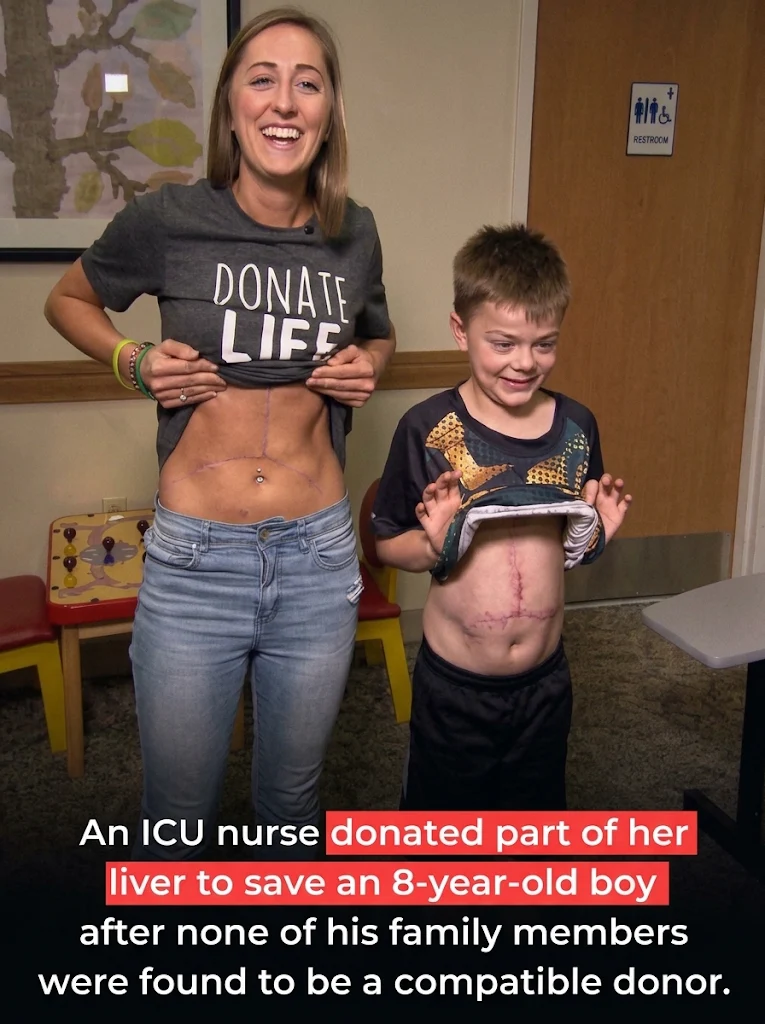
Photographs showed the two smiling together and displaying their surgical scars.
Their matching scars became a visible reminder of the operation that had given Brayden another opportunity to live a normal childhood.
Loritz also used the attention surrounding their story to encourage public awareness about living organ donation.
In a September 2019 Facebook message quoted by ABC News, she expressed gratitude to her family, friends, hospital colleagues and everyone who had supported them.
She also encouraged people to learn more about living donation and how it can help address the shortage of available organs.
Why living liver donation matters
The story also highlights an important aspect of modern transplant medicine.
Unlike some other organs, the liver has a remarkable ability to regenerate. This makes living-donor liver transplantation possible in carefully selected cases.
During the procedure, a medically suitable donor gives part of their liver to a recipient. The remaining liver tissue in the donor and the transplanted portion in the recipient can grow and adapt over time.
However, living donation is major surgery and is not without risk. Donors must undergo extensive medical and psychological evaluations, and decisions must be made voluntarily without pressure.
The procedure requires experienced transplant teams and careful follow-up care for both individuals.
For families facing severe liver disease, living donation can sometimes provide an additional treatment option when a suitable deceased-donor organ is not immediately available.
A story of compassion and a second chance
The experience of Cami Loritz and Brayden Auten remains a memorable example of how medical knowledge, generosity and human compassion can come together.
In 2019, a young boy faced a serious medical emergency that left his family searching for a compatible liver donor. When relatives and friends could not provide a suitable match, an ICU nurse who heard about his situation volunteered to help.
Her decision led to a successful transplant and an emotional connection between two people who had previously been strangers.
Although the original medical reports do not establish Brayden’s health status many years later, they documented a successful operation and encouraging recovery during 2019.
For Loritz, the experience also became an opportunity to encourage others to learn about living organ donation.
Her story reminds readers that helping another person does not always require knowing them personally. Sometimes, an act of generosity can give an entire family something they had feared losing: hope and another chance to be together.