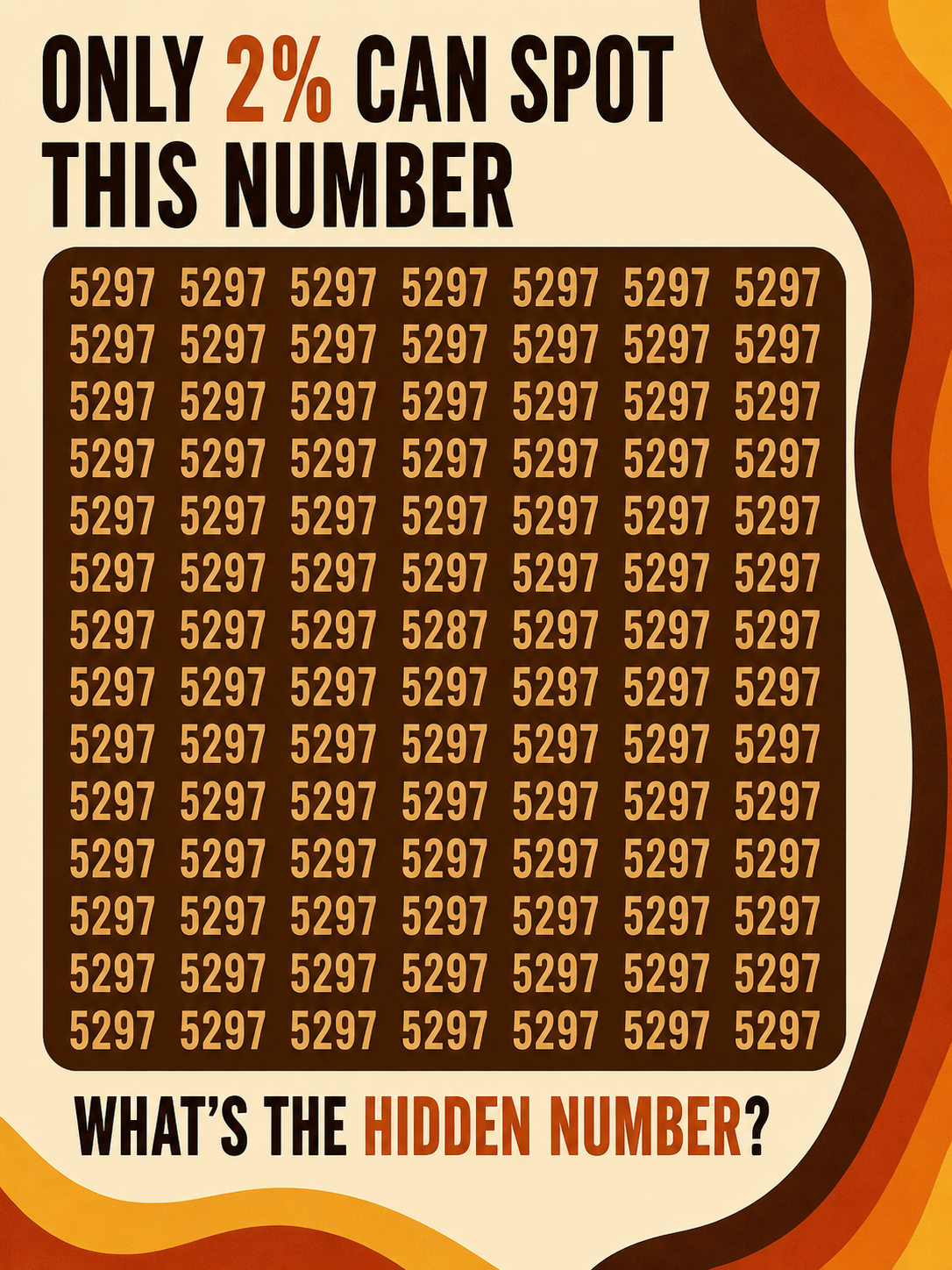
ONLY 2% CAN SPOT THIS NUMBER WHAT’S THE HIDDEN NUMBER?
At first glance, this image appears to be a simple number puzzle, but it is carefully designed to test visual attention, concentration, and pattern recognition. The challenge asks viewers to locate one number that differs from hundreds of nearly identical numbers. Although it looks easy, the repetitive layout makes the hidden number surprisingly difficult to find, demonstrating how the human brain processes familiar patterns.
The large headline at the top reads, “ONLY 2% CAN SPOT THIS NUMBER.” This statement immediately captures attention by creating curiosity and a sense of competition. Whether or not the “2%” statistic is accurate is impossible to verify, but psychologically it encourages people to believe the puzzle is difficult. When people are told that only a small percentage can solve something, they naturally become more determined to prove they belong to that group. This is a common technique used in online puzzles, brain teasers, and social media challenges to increase engagement.
The main section of the image consists of a large dark brown rectangle filled with rows and columns of the number 5297. Every number appears nearly identical in size, spacing, and color. Because the brain quickly recognizes repeated patterns, it begins to scan groups of numbers instead of reading each digit individually. This makes even a tiny difference difficult to notice.
Hidden within the grid is a different number: 5287. The only change is that the third digit has changed from a 9 to an 8. Since both numbers share the same first, second, and fourth digits, the difference is extremely subtle. The puzzle relies on the fact that our eyes often overlook small variations when surrounded by repetitive information.
This type of challenge is an example of a visual search puzzle. Similar puzzles have been used for decades in newspapers, magazines, educational books, and psychology experiments. They are not designed to measure intelligence directly. Instead, they evaluate several mental skills, including attention to detail, visual discrimination, concentration, and patience.
Visual discrimination is the ability to recognize small differences between objects that appear almost identical. It is an important skill used in many everyday activities. Proofreaders search for spelling mistakes in long documents. Air traffic controllers monitor radar screens filled with similar symbols. Radiologists carefully examine medical images for tiny abnormalities. Security personnel compare passports and identification photos for subtle differences. While this puzzle is much simpler than those real-world tasks, it exercises the same fundamental ability to notice small details within repetitive information.
The puzzle also demonstrates an interesting feature of human perception known as pattern recognition. Our brains are remarkably efficient because they do not examine every piece of visual information individually. Instead, they identify familiar patterns and fill in missing details automatically. This allows us to read quickly, recognize faces instantly, and navigate busy environments without consciously analyzing every object we see.
However, this efficiency also creates blind spots.
When the brain expects every number to read 5297, it begins assuming that each group is identical. Instead of checking every digit carefully, the mind predicts what it expects to see. This mental shortcut saves time but increases the chance of overlooking the hidden number.
The warm retro design of the poster also contributes to its appeal. The cream-colored background contrasts with the dark brown puzzle area, making the numbers stand out clearly. Along the right edge and lower left corner, flowing waves of orange, yellow, rust, and brown create a vintage 1970s-inspired appearance. These decorative elements make the puzzle visually attractive without distracting too much from the main challenge.
At the bottom, the bold question “WHAT’S THE HIDDEN NUMBER?” encourages viewers to continue searching even if they have already spent several minutes examining the grid. This simple prompt transforms the image from a decorative graphic into an interactive experience.
One interesting aspect of puzzles like this is that different people use different solving strategies. Some scan one row at a time from left to right. Others divide the puzzle into smaller sections. Some focus only on the third digit, since that is where the variation occurs. Others allow their eyes to move naturally until something “looks different.” Research suggests that systematic scanning often produces better results than randomly jumping around the page.
Many people become frustrated because they repeatedly look directly at the hidden number without recognizing it. This happens because the brain continues interpreting it as the expected pattern. Taking a short break or changing the viewing angle can sometimes make the difference immediately noticeable.
Although these puzzles are entertaining, it is important to understand what they do—and do not—measure. Successfully finding the hidden number does not necessarily mean someone has a higher IQ, nor does missing it indicate poor intelligence. Performance can be influenced by factors such as fatigue, lighting, eyesight, screen size, concentration, and even how quickly someone chooses to scan the image.
Ultimately, this picture is an engaging demonstration of how human perception works. It reminds us that our brains constantly rely on shortcuts to process the enormous amount of visual information we encounter every day. Those shortcuts usually help us work efficiently, but they can also cause us to overlook tiny details hidden in plain sight. That combination of psychology, observation, and curiosity is what makes visual puzzles like this so popular and enjoyable for people of all ages.