“People Left Seriously Baffled Over This Viral Picture: ‘That Took Me Way Too Long’,
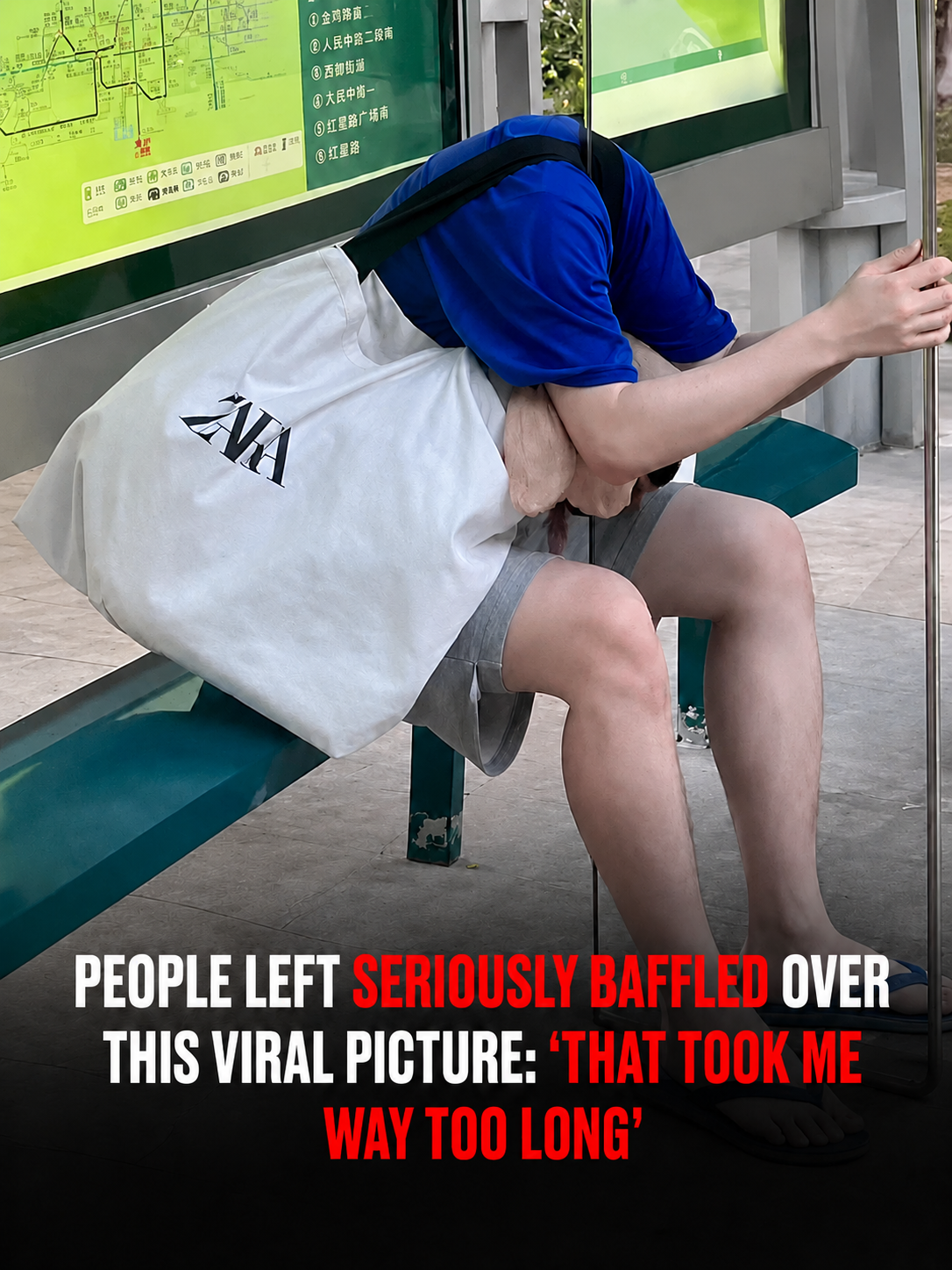
The photograph appears to show a person sitting alone at a bus stop or public transit shelter. The individual is wearing a bright blue shirt, gray shorts, and flip-flops while carrying a large white tote bag over one shoulder. Their body is bent forward, with one arm wrapped around a vertical pole that supports the bus shelter. At first glance, however, the person’s posture creates a very misleading illusion.
The confusion begins because the person’s head is completely hidden from view. Instead of seeing a face, viewers only see folded arms, a shoulder, and part of the neck. Since our brains naturally try to recognize familiar human shapes, many people mistakenly believe they are looking at a body with missing or strangely positioned body parts. The brain fills in gaps with incorrect assumptions before carefully analyzing the image.
The large white tote bag adds another layer of confusion. Because it covers much of the person’s torso, it becomes difficult to tell exactly where the person’s body begins and ends. The black shoulder strap blends into the blue shirt, making it seem as though the bag and clothing are part of the person’s body. This causes viewers to lose track of the body’s actual orientation.
The bus stop pole also plays a significant role in the illusion. It runs vertically through the center of the image and visually divides the scene into separate sections. Initially, many people assume the pole is behind the person, when in reality the individual is leaning around it while hugging it with one arm. That misunderstanding changes how the entire body is interpreted.
Another reason this image fools people is that the person’s head is tucked beneath one arm. The forearm partially hides the face while the upper body is folded over, creating the illusion that the neck and shoulders are positioned in impossible ways. Until viewers locate the hidden head, the entire posture appears anatomically impossible.
Human vision depends heavily on pattern recognition. Our brains are designed to recognize faces, limbs, and body positions almost instantly because doing so helps us understand our surroundings quickly. Usually this system works extremely well, but occasionally an unusual camera angle, overlapping objects, or hidden body parts cause the brain to make an incorrect first impression. This picture is a classic example of that phenomenon.
Psychologists refer to this as a visual illusion or perceptual ambiguity. Instead of processing every detail independently, the brain builds the most likely interpretation using incomplete information. When new visual clues appear, the brain suddenly reorganizes the scene, producing the familiar “Aha!” moment when the correct image finally becomes obvious.
Many people who first encountered this photograph reported seeing several different things before understanding the scene correctly. Some believed the person was facing the opposite direction. Others thought there were two people sitting together. Some even wondered whether the image had been digitally manipulated. In reality, nothing supernatural or impossible is happening—it is simply an unfortunate combination of perspective, posture, and hidden body parts.
The person’s actual position is much simpler than it first appears. They are sitting on the bench while leaning forward with their upper body folded over. Their head is tucked down beneath their arm, making it almost completely invisible from the camera’s angle. One arm reaches around the pole, and the oversized tote bag covers much of the torso, making the posture difficult to interpret at first glance.
Images like this frequently go viral because they invite viewers to spend time solving a visual puzzle. Once someone understands the illusion, they often share it with friends to see how long it takes others to notice the correct perspective. This social aspect contributes to the popularity of such photographs across social media platforms.
It’s worth noting that the image itself does not necessarily tell us anything about the person’s emotional state or situation. While they appear to be resting or leaning forward, it would be speculative to conclude they are exhausted, upset, or in distress based solely on a single photograph. The viral appeal comes from the optical illusion created by the camera angle rather than from the person’s actions.
Ultimately, this photograph is a reminder that our eyes do not simply record reality like a camera. Instead, our brains constantly interpret and reconstruct what we see using assumptions based on experience. Most of the time those assumptions are accurate, but occasionally a perfectly ordinary scene can become an intriguing visual puzzle. That is exactly what happened here—a normal person sitting at a bus stop was photographed from an angle that tricks the brain into seeing something impossible. Once you notice where the person’s head and arms actually are, the confusing image suddenly makes perfect sense, which is why so many viewers say, “That took me way too long.”