
The Whale That Shouldn’t Have Been There
Location: Inland river waterways, United States
Date of News: September 9, 2026
No one could explain it at first.
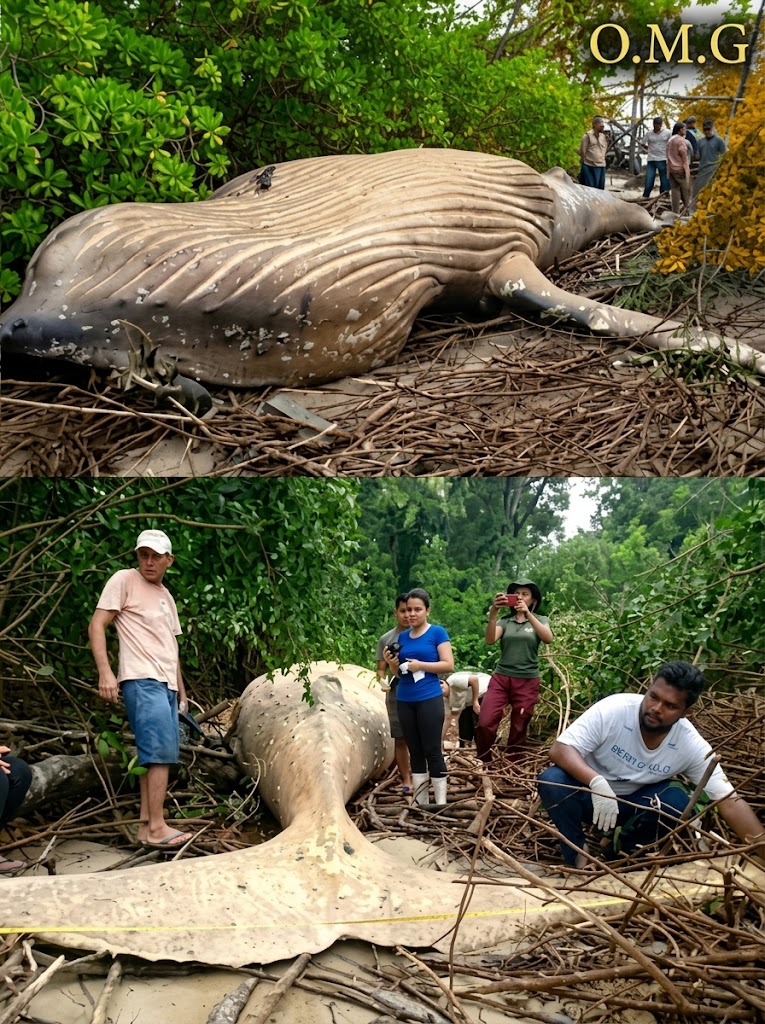
Deep inland, far from the open ocean, something enormous lay among mud, branches and shallow water. From a distance, local residents could barely make out what they were seeing. Some thought it was a large piece of driftwood. Others assumed it was the remains of a boat or perhaps some strange object carried downstream by a flood.
Then someone realized what it was.
A whale.
The discovery immediately transformed an ordinary stretch of inland water into the center of a mystery.
Whales belong to the ocean. Their enormous bodies are built for marine environments, their migrations follow complex underwater routes, and their survival depends on conditions that freshwater rivers generally cannot provide.
Yet history has repeatedly shown that whales sometimes enter rivers and estuaries, traveling astonishing distances away from the coast.
One of the most remarkable recent examples occurred in Washington state in 2026, when a juvenile gray whale traveled roughly 20 miles up the Willapa River before it was later found dead near Raymond. Researchers believed poor nutritional condition may have played a role in the whale’s unusual journey.
The sight was extraordinary.
The story was heartbreaking.
And it raised a question that has fascinated scientists and ordinary people for generations:
Why would a whale leave the ocean and travel into a place where it seemingly does not belong?
A Giant Where Nobody Expected One
When a whale appears in an inland waterway, the first reaction is usually disbelief.
People gather along riverbanks.
Boats slow down.
Drivers stop on bridges.
Phones come out.
Photographs spread rapidly.
The animal becomes an unexpected celebrity.
But behind the fascination is a serious biological problem.
A whale that has entered an unfamiliar waterway may face shallow water, freshwater, boat traffic, bridges, dams, underwater obstacles, poor food availability and extreme physical stress.
In some cases, the animal manages to find its way back to the ocean.
In others, it becomes stranded or dies.
The 2026 Washington gray whale illustrates how complicated these situations can become.
According to reporting from the Associated Press carried by CNA, the juvenile gray whale had traveled approximately 20 miles up the Willapa River. The whale was later found dead near Raymond. A researcher with Cascadia Research Collective suggested hunger could have contributed to the animal’s behavior, as gray whales have faced increasing challenges finding enough food.
The whale’s journey was not simply an unusual sightseeing event.
It was potentially a sign that something was wrong.
When Hunger Changes a Migration
Gray whales undertake one of the longest migrations of any mammal.
They travel between breeding areas and feeding grounds, following seasonal patterns that have evolved over countless generations.
But migration is not simply a matter of following a map.
Whales respond to food, environmental conditions, temperature, currents and other biological signals.
When those conditions change, animals can behave differently.
The Washington whale was reportedly thin and malnourished. Scientists examining its situation considered whether the search for food might have contributed to its unusual movement into the river.
That possibility makes the story more troubling.
A whale traveling inland may look adventurous to human observers.
For the animal, however, the journey may represent desperation.
It may be searching for prey.
It may be confused.
It may be responding to environmental changes.
Or it may simply have taken a wrong turn and been unable to find its way back.
Scientists cannot always determine the answer immediately.
The Whale Nearly 1,000 River Miles From the Sea
The mystery becomes even more striking when looking at an earlier case.
In 2006, canoeists discovered the carcass of a young beluga whale in Alaska’s Tanana River.
The location was extraordinary.
The whale was found about 40 miles southwest of Fairbanks and nearly 1,000 river miles from the Bering Sea, the closest area associated with beluga habitat.
Researchers identified the carcass and concluded that the animal had almost certainly reached the river from the ocean.
But how?
And why?
Those questions remained difficult to answer.
The Tanana River is a freshwater system running through Alaska’s interior, far from the environment where belugas normally live.
A researcher from the University of Alaska Museum of the North said he was confident the whale had swum from the ocean, noting that the alternative explanation—a deliberate placement of a whale carcass in such a remote area—was highly implausible.
The discovery became one of the strangest examples of a marine mammal appearing deep inside an inland river system.
It demonstrated something scientists already knew but repeatedly found surprising:
Whales can travel much farther into rivers than most people imagine.
The Famous Whale That Took the Wrong Turn
Perhaps one of the best-known examples is Humphrey, a humpback whale whose adventures through Northern California waterways captivated the public.
In 1985, Humphrey entered San Francisco Bay and eventually traveled far upstream into the Sacramento River system.
The journey turned him into a media sensation.
People lined roads and riverbanks hoping to catch a glimpse of the enormous animal.
Scientists and rescuers followed his movements closely.
But the excitement was accompanied by growing concern.
The farther Humphrey traveled inland, the more difficult it became to get him back toward the ocean.
Historical reporting described him swimming at least 50 miles up the Sacramento River, moving deeper into freshwater territory.
Rescuers attempted different strategies to encourage him to turn around.
Some techniques involved sounds intended to make the area behind him uncomfortable while encouraging him toward deeper water in the direction of the ocean.
Eventually, Humphrey became one of the most famous examples of a whale becoming lost in inland waterways.
His story also demonstrated how complicated human intervention can be.
Saving a whale is not as simple as putting a rope around it and pulling it toward the sea.
A whale is enormously heavy.
Its body can be injured easily.
Stress can become dangerous.
Boats can accidentally collide with it.
Shallow water can trap the animal.
And human activity can sometimes make an already frightened animal even more distressed.
When the Crowd Arrives
Whenever a whale appears in an unexpected location, people naturally want to see it.
That human fascination is understandable.
Whales are among the largest animals ever known to have lived on Earth. Most people will never see one at close range.
So when one suddenly appears near a community, residents feel as though they have witnessed something extraordinary.
But wildlife experts often have another concern.
Too many people can become dangerous.
Boats can crowd the animal.
People may attempt to approach it.
Noise can increase.
Drones may be flown overhead.
Photographers may gather along the shoreline.
Even well-intentioned attention can create additional stress.
For this reason, authorities and marine mammal experts typically urge members of the public to maintain distance and allow trained responders to assess the animal.
The goal is not simply to give everyone a closer look.
The goal is to determine whether the animal is healthy, whether it can return to the ocean naturally and whether intervention is actually necessary.
Not Every Whale Can Be Saved
That is perhaps the hardest lesson in stories like these.
People often assume that if a whale is stranded, humans should immediately rescue it.
But intervention can carry its own risks.
A whale that appears stranded may have an underlying illness.
It may be severely malnourished.
It may have suffered an injury.
It may be experiencing neurological problems.
It may have become disoriented.
And sometimes the cause of the behavior cannot be determined until after the animal dies.
A recent scientific report describing a successful rescue of a juvenile humpback trapped upstream of a tidal power station in France demonstrated how complicated these operations can be. In that case, rescuers used environmental and water-management techniques rather than simply attempting to physically drag the whale out. The whale was successfully guided back toward open water after a two-day operation involving approximately 100 people.
That success is encouraging.
But it also illustrates how specialized whale rescue can be.
Every situation is different.
The River Is Not the Ocean
One of the most important facts about these incidents is that freshwater and marine environments are fundamentally different.
Whales have evolved to survive in saltwater.
Their bodies are adapted to marine ecosystems.
Their food sources are often associated with ocean environments.
Even when a whale can physically tolerate freshwater for a period of time, that does not mean it can survive indefinitely.
A whale that travels too far upstream can encounter another major problem: geography.
Rivers narrow.
Water becomes shallower.
Bridges and locks interrupt the route.
Dams can create barriers.
Eventually, the animal may find itself trapped.
At that point, the journey that began as a search for food or an accidental navigation error can become a life-threatening situation.
Why Does It Happen?
Scientists do not have one universal explanation for why whales enter rivers.
Different species behave differently.
Different individual animals may respond differently to environmental conditions.
In some cases, young or inexperienced animals may become disoriented.
In others, whales may follow prey into unfamiliar waters.
Injuries or illness may alter normal behavior.
Environmental changes may also influence migration and feeding patterns.
A pair of humpback whales once traveled nearly 100 miles up California’s river delta system, for example. Scientists were unable to definitively explain why the animals entered the inland waterways, although the whales had visible injuries believed to have been caused by boat propellers.
The case showed that there may not always be a simple explanation.
Nature does not operate according to human expectations.
A Warning Beneath the Mystery
The image of a whale lying in muddy inland water can feel almost surreal.
It looks like a scene that should not exist.
A creature designed for the vastness of the ocean is suddenly surrounded by trees, mud, boats and riverbanks.
But perhaps the most important part of the story is not the mystery.
It is the warning.
Unusual wildlife behavior can sometimes provide scientists with clues about changing environmental conditions.
If an animal is struggling to find food, its behavior may change.
If migration routes become less reliable, individuals may wander.
If ecosystems change, species may respond in unexpected ways.
The 2026 gray whale case in Washington drew attention partly because researchers were concerned about the animal’s poor nutritional condition.
One whale cannot prove that an entire ecosystem is collapsing.
But unusual events can encourage scientists to ask important questions.
Are food supplies changing?
Are ocean conditions shifting?
Are whales facing greater competition for prey?
Are warming waters affecting marine ecosystems?
Are human activities increasing the risks faced by migrating animals?
Those questions are much larger than the image of a single whale in a river.
The Silence After the Discovery
Imagine standing beside the river.
The crowd has gathered.
The cameras are pointed toward the water.
The whale’s enormous body moves slowly through the shallows.
For a moment, nobody speaks.
People simply watch.
It is easy to feel wonder.
But there is another emotion underneath it.
Concern.
Because the whale is not supposed to be there.
The sight is beautiful precisely because it is so unusual.
And that same unusualness makes it frightening.
The animal has crossed an invisible boundary between the world it evolved to inhabit and a place that may offer little chance of survival.
Eventually, the crowd leaves.
The boats move away.
The cameras disappear.
What remains is the whale and the water.
Scientists continue studying.
Rescuers continue working when intervention is possible.
And the public waits for news.
Sometimes the whale turns around.
Sometimes it is successfully guided back to the sea.
Sometimes it dies.
There is no guaranteed ending.
A Story Bigger Than One Whale
The title “The Whale That Shouldn’t Have Been There” captures the first reaction most people have when they see such an animal far inland.
But perhaps the more important question is not why the whale was there.
It is what its presence can teach us.
Whales do not read maps.
They do not understand political borders.
They do not know that humans have divided rivers into shipping lanes, ports and industrial zones.
They follow instinct, food, currents and environmental signals.
When something changes, their behavior can change with it.
That is why every unusual whale sighting matters.
Not because every wandering whale represents an environmental catastrophe, but because each incident gives researchers another opportunity to understand these enormous and mysterious animals.
The young gray whale that traveled up Washington’s Willapa River in 2026 became a symbol of that mystery. It traveled far inland, attracted widespread attention and ultimately died. Researchers considered hunger and poor nutritional condition among possible explanations.
The beluga found in Alaska in 2006 remains an even more astonishing example, discovered nearly 1,000 river miles from the sea.
And Humphrey’s journeys through California decades earlier demonstrated how a whale can become lost in waterways that seem impossibly far from its natural habitat.
Each story is different.
But together, they reveal the same remarkable truth.
The ocean is not as isolated from our inland world as we sometimes imagine.
Rivers connect landscapes.
Tides carry marine life into estuaries.
Animals follow opportunities and instincts that humans do not always understand.
And occasionally, one of the largest creatures on Earth appears in a place where nobody expected to see it.
When that happens, the first response may be astonishment.
Then comes the question.
Then comes the science.
And sometimes, tragically, comes the realization that the whale was not lost because it was adventurous.
It may have been lost because something was already wrong.
That is what makes these stories so haunting.
The whale should not have been there.
But once it was, the world had no choice but to stop and look.