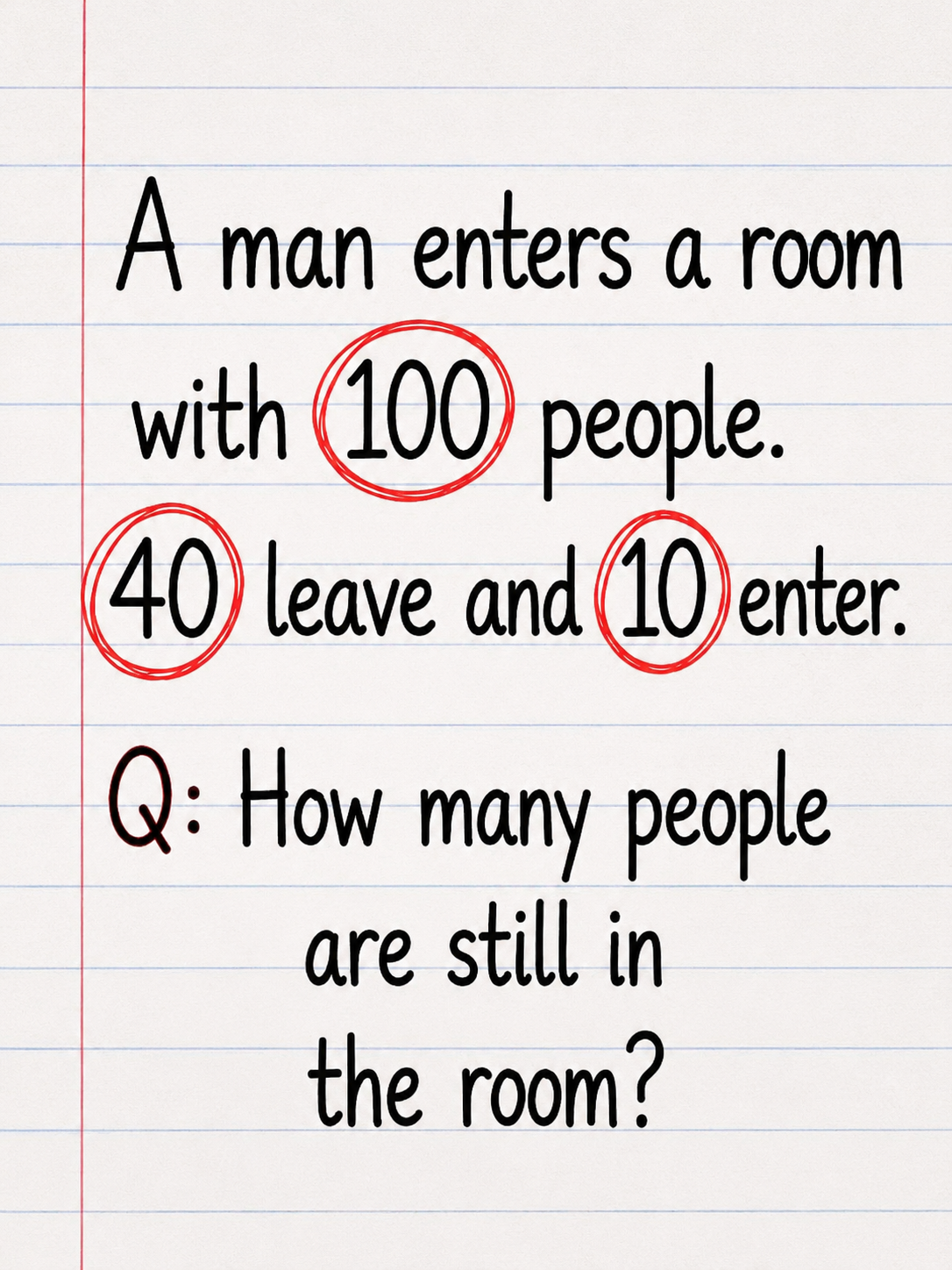
A man enters a room with 100 people.
This image presents a classic logic puzzle that appears simple at first glance but is designed to test whether the reader pays attention to the wording rather than rushing to perform arithmetic. Many people immediately calculate 100 − 40 + 10 = 70, assuming that the answer is straightforward. However, the puzzle contains a subtle detail that changes the correct interpretation. The key lies in the very first sentence: “A man enters a room with 100 people.”
The phrase indicates that the room already contains 100 people before the man arrives. When the man enters, he becomes an additional person in the room. At that moment, there are 101 people inside the room. This is the first trick of the puzzle, because many readers overlook the fact that the entering man should also be counted.
The next sentence states that 40 leave and 10 enter. Since the puzzle does not specify that the man who entered initially is one of the people leaving, we assume that forty people leave the room from the total group currently inside. Starting from 101 people, subtracting 40 leaves 61 people. Then, 10 more people enter, increasing the total to 71 people.
Therefore, under the most natural reading of the puzzle, the correct answer is 71 people.
The reason so many people answer 70 is that they instinctively begin with the number 100, forgetting to include the man mentioned in the first sentence. This illustrates an important lesson about reading comprehension: people often assume the first number given is the starting total without carefully considering the entire sentence.
The puzzle is also an example of how wording can influence human thinking. Our brains naturally focus on numbers because they seem to provide all the information needed for a calculation. Once we see 100, 40, and 10, we tend to perform the arithmetic automatically. This mental shortcut, sometimes called cognitive bias or heuristic thinking, helps us solve everyday problems quickly, but it can also cause us to overlook important details.
Another interesting aspect of the puzzle is its use of ordinary language. The sentence “A man enters a room with 100 people” can be interpreted in two slightly different ways. One interpretation is that the man enters a room that already contains 100 people, making the total 101. Another, less common interpretation is that the man enters together with a group of 100 people, although this reading is generally not intended. Because of this ambiguity, discussions about the puzzle often arise online, with different people defending different answers.
The image also uses visual emphasis to draw attention to the numbers. The numbers 100, 40, and 10 are circled in red, encouraging readers to focus on the arithmetic rather than the wording. This is a clever design choice because it reinforces the common mistake. The large, handwritten-style font and notebook background make the puzzle feel informal and approachable, further encouraging people to answer quickly instead of analyzing the text carefully.
Logic puzzles like this are popular on social media because they generate engagement. People often comment with different answers, explain their reasoning, and debate the correct interpretation. The puzzle succeeds not because the mathematics is difficult—it only involves basic addition and subtraction—but because it challenges the reader’s attention to detail. It reminds us that careful reading is just as important as mathematical ability.
This type of puzzle is frequently used in classrooms, interviews, and brain-training exercises to encourage critical thinking. Rather than testing advanced knowledge, it rewards patience and precision. Before solving any problem, it is important to understand exactly what is being asked and to identify all the relevant information.
In conclusion, the puzzle teaches that assumptions can lead to incorrect answers. If the room initially contains 100 people, and one man enters, there are 101 people. After 40 leave, 61 remain. When 10 more people enter, the final total becomes 71 people. The seemingly obvious answer of 70 results from forgetting to count the man who entered in the first sentence. The puzzle is an excellent reminder that reading carefully and thinking critically are often more important than performing calculations quickly.