A Stranger Offered Me Food at a Bus Station — Neither of Us Expected What Happened Next See more
The intense, humid air inside the traditional Maasai dwelling felt heavy against my skin. This wasn’t the plan. This wasn’t even the continent I had expected to be in two days ago. My name is Anya, and my life had been a meticulously curated spreadsheet. A career in data analytics, a perfectly scheduled apartment, and a boyfriend who used a calendar to plan our dates. But sometimes, the universe has other plans for your spreadsheets.
It started three days ago, thousands of miles away at a chaotic transit hub—the sprawling, exhaust-choked Central Bus Terminal in Nairobi. I was on a solo, well-researched backpacking trip, my first after a promotion. The plan was to blend in, take notes, and see the “real” Kenya. But the reality was a bit overwhelming. I’d missed my connecting bus to a wildlife reserve, my Swahili was rudimentary at best, and I was starving, having skipped breakfast in a rush. I was perched on my heavy pack, feeling increasingly conspicuous and out of place, trying to decode a confusing departure board.
That’s when I heard it. A gentle voice, speaking not Swahili, but a clear, accented English. “You look lost, sister. And hungry. Come.”
I looked up, startled. Standing before me was a man who radiated an unexpected warmth. He wasn’t dressed like the tourists in their khakis, nor like the frantic locals. He wore a clean, faded shirt and trousers. But it was his eyes—kind, crinkled at the corners, and utterly genuine—that made me pause. He was holding a small, steaming paper package tied with twine.
“I am Isaac,” he continued, offering the package. “Just some chapati and nduma (taro) I bought from a vendor. It is simple, but good.”
My stomach rumbled, traitorously loud. The “stranger danger” warnings from my guidebooks clashed with the gnawing hunger. He seemed so earnest. I hesitated for a second, then smiled, accepting the package. “Thank you. I’m Anya. You’re a lifesaver.”
He sat down beside me on a concrete bench, not invading my space, just sharing the moment. We ate, the delicious, slightly salty chapati dissolving the tension in my stomach. He wasn’t begging; he was just… hospitable. We didn’t talk much, just the shared comfort of food. As we finished, he looked at my confused map. “Where you trying to go, Anya?”
When I told him, his expression shifted from kind to a gentle pity. “Ah, that one… it’s complicated today. Many delays. But… my brother has a small vehicle. He is heading towards that general direction tomorrow morning. He can take you part of the way. It is not a luxury bus, but it is safe.”
This was it. The classic tourist trap. The friendly local with the “brother’s vehicle.” My data-driven brain screamed scam. But something made me override it. Perhaps it was his open face, perhaps it was the sheer exhaustion. “Really? That would be amazing. How much?”
Isaac just smiled. “For food, we don’t charge. For a ride, you can pay my brother what you think is fair for fuel. We are just neighbors, far from home.”
This simple, profound statement disarmed me completely. “Neighbors, far from home.” He was referring to being a stranger in his own country’s capital, a city just as vast and impersonal to many Kenyans as it was to me. We exchanged numbers, his a simple prepaid phone, mine a smartphone I was suddenly glad to have.
The next morning, I met Isaac and his brother, David, at a different, less busy spot near the station. The vehicle was a battered but functional minibus, filled with sacks of produce and other passengers, none of whom looked like tourists. The journey was an adventure in itself, bumpy, loud with music, and filled with glimpses of the countryside I would never have seen from a tour bus. David was quiet but competent; Isaac kept the conversation going, pointing out landmarks, explaining things I saw.
It wasn’t a direct route, and by late afternoon, we had to stop near a small village not far from the Maasai Mara region. Isaac explained that he and David had some family business nearby, and their route deviated. “From here, you can get another matatu (minibus taxi) to your reserve. It’s a short wait.”
As I prepared to say goodbye and pay, Isaac put a hand on my arm. “Wait, Anya. My cousin is a morani (Maasai warrior) from the village just over that ridge. He often helps travelers who get stuck. It’s safer than waiting here alone. Would you like to meet him and perhaps stay the night in a traditional boma (homestead)? It would be an experience you won’t forget.”
Again, the internal alarm bells rang. A warrior? A homestay? But the adventure-seeker I hadn’t known was inside me took over. “Okay,” I said, my voice trembling slightly. “Lead the way.”
We walked for about an hour through golden, dry grasslands, the sun sinking low, painting the sky in fiery hues. As we approached a cluster of mud and thatch huts, several tall figures, their bodies draped in vibrant shukas (red checkered blankets), emerged. They carried spears and traditional wooden clubs. My heart hammered against my ribs.
Isaac called out a greeting in Maa, the Maasai language. The warriors responded, their faces stern but not hostile. One, taller and with an air of quiet authority, approached us. This was his cousin, Leyian.
Isaac explained my situation, his tone respectful. Leyian listened, then looked at me with deep, serious eyes. He nodded once. “A visitor in need is a gift. You are welcome.”
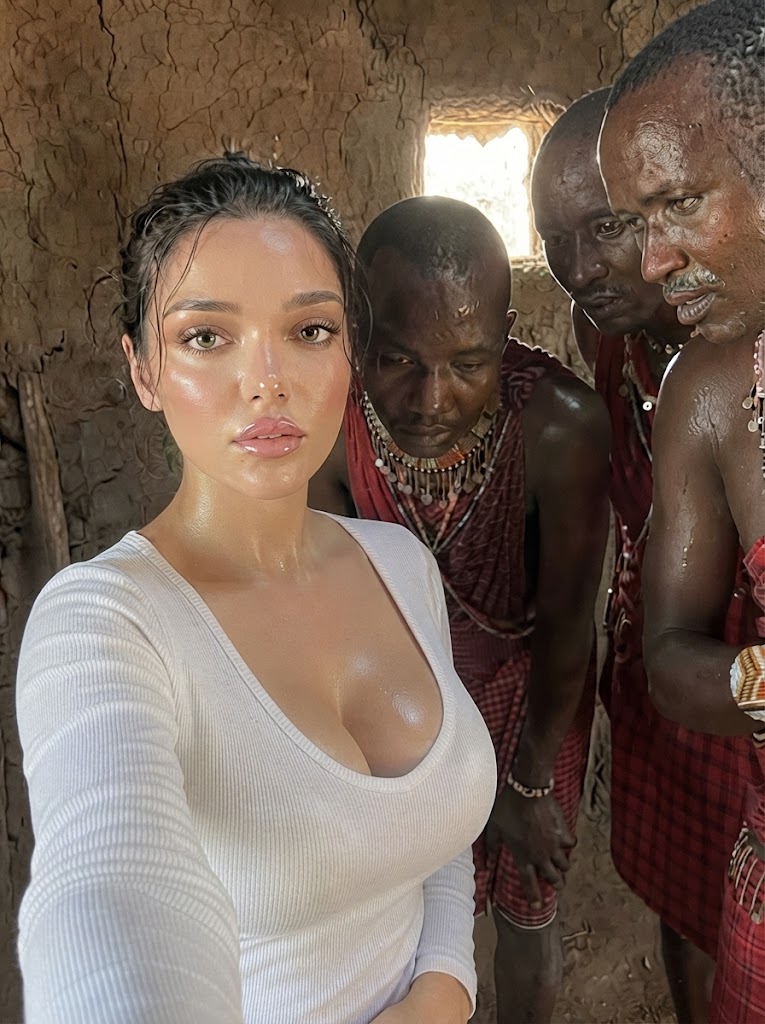
That’s how I ended up in the image that prompted this story—a selfie I took inside his boma later that evening. I’m in the white long-sleeved top I’d been wearing since the bus station. The lighting is dim, illuminated by a small solar lantern and the soft, smoky glow from the central hearth. My skin is dewy with the sweat of the humid, fire-warmed interior.
I’m looking at the camera with a wide-eyed, perhaps slightly overwhelmed expression. Behind me, crowding into the frame, are Leyian and two other warriors. Their faces are serious, studying the screen of my phone. The texture of the mud-and-dung wall is visible behind them. Their beaded necklaces and traditional shukas are clear. It’s an image of profound contrast—my polished, modern self and their ancient, vibrant culture, momentarily colliding in the most intimate of spaces.
That night, I didn’t stay in a hotel. I slept on a simple kitanda (bed frame with woven hide) in a section of Leyian’s boma, separated from the livestock area by a low partition. I ate a stew made with goat meat and cornmeal porridge, sitting with the family around the central fire. Leyian, through Isaac’s translation, told me stories of his people, their traditions, and their challenges. He spoke of the land, of the wildlife they coexist with, and of their pride. I, in turn, tried to explain my life, the data, the spreadsheets. They listened with patience and a kind of polite curiosity that was both humbling and endearing.
The next morning, after a breakfast of milk and tea, Leyian himself escorted me to the main road and flagged down a reliable matatu. As I boarded, I tried to offer money again, this time to Leyian, for their hospitality.
Leyian simply shook his head. “We do not sell our welcome, Anya. You shared our food, our fire, and our stories. You are not a guest anymore; you are a friend.”
Isaac, who had accompanied us, added, “A stranger offered food, and a friend found a home. We didn’t expect that, either.”
I waved goodbye, watching them recede in the dust, the spears of the warriors gleaming in the morning sun. The bus station, with its impersonal crowds and my desperate hunger, felt like a lifetime ago. My carefully planned, data-driven trip had taken an unscripted turn into the heart of human connection. I hadn’t found the “wildlife” I’d originally come for in the way I’d imagined, but I had found something infinitely more valuable: a reminder that kindness, hospitality, and friendship don’t require a shared language, only a shared humanity. The spreadsheets of my life could wait; I had a whole new world to learn about, one stranger, and one unexpected friendship, at a time. The “See More” in the headline isn’t about a product or a gimmick; it’s an invitation to see more of the world, and more importantly, more of yourself, reflected in the unexpected faces you meet along the way. The adventure hadn’t ended; it was just beginning.