
Did You Know That an Older Woman…
Margaret stood in front of the mirror at fifty-eight years old, really looking at herself for the first time in decades. The woman staring back wasn’t the one she remembered from photographs—not because she looked worse, but because she finally saw someone worth actually noticing.
It had started three months earlier, on an ordinary Tuesday morning, when her daughter called to say she wouldn’t be coming home for Christmas. Again. Margaret had stood in her kitchen, phone pressed to her ear, and felt something shift inside her chest—not heartbreak exactly, but a strange kind of clarity. She had spent thirty-four years organizing her life around her children’s schedules, her husband’s career, her mother’s declining health, and her job as a middle school librarian. She had become so practiced at saying “yes” to everyone else that she couldn’t remember the last time she’d said yes to herself.
That evening, Margaret did something she hadn’t done in years: she sat on her back porch alone, with no one to tend to, nothing that absolutely needed doing immediately, and she let herself cry. Not pretty tears, but the kind that came from somewhere deep inside, years of accumulated surrender pouring out of her. When she finally stopped, her face blotchy and her breathing ragged, she felt oddly lighter. The heaviness that had become so familiar she’d stopped noticing it had lifted just slightly.
The next morning, Margaret called her boss and requested a two-week leave of absence. Then she drove to a vintage clothing boutique on the other side of town—a place she’d passed a hundred times but never entered because she was always rushing somewhere else.
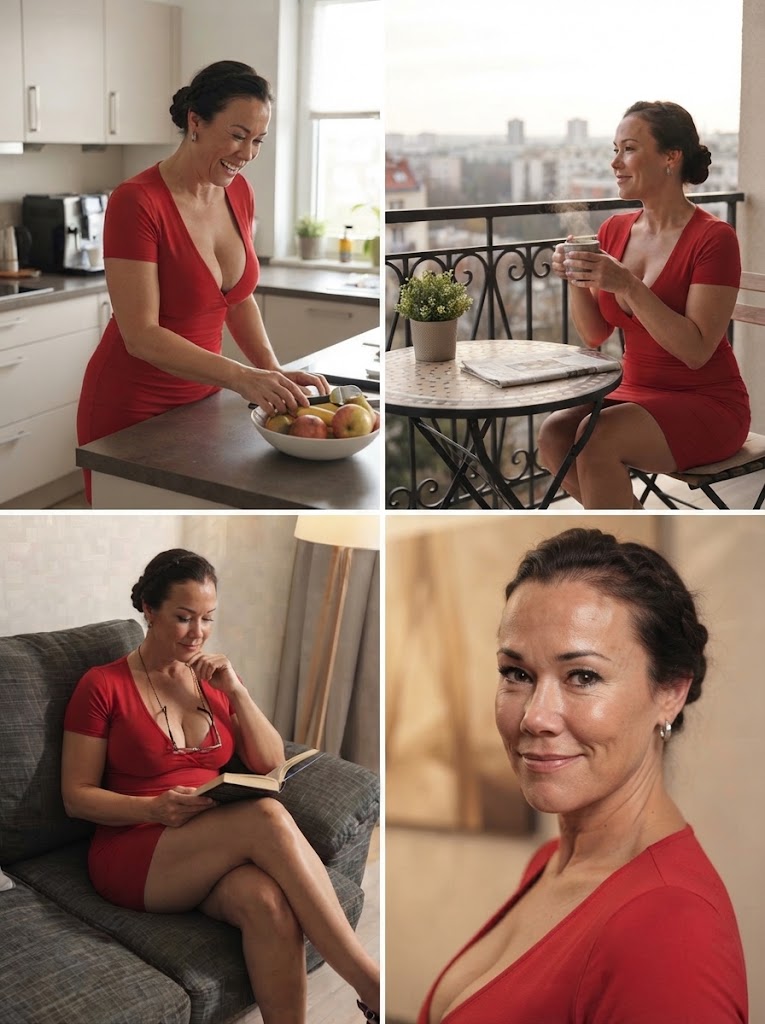
Inside the shop, the air smelled like lavender and possibility. A young woman with purple streaks in her hair asked if she needed help finding anything. Margaret pointed to a red dress hanging near the window—a simple, bold silk number with short sleeves and a cut that looked nothing like the sensible cardigans and neutral palettes that currently filled her closet.
“That’s a stunning choice,” the young woman said. “Not everyone can pull off that kind of red.”
Margaret bought the dress without trying it on first, which was so unlike her that she almost laughed at herself. But as she held the tissue-wrapped package in her car, she felt something she couldn’t quite name yet. Anticipation, maybe. Hope.
She wore the red dress to dinner alone at a restaurant she’d always wanted to try but never had because her husband wasn’t interested in “fancy food.” The hostess seated her at a small table by the window. As Margaret opened the menu, she noticed people looking at her—not judgmentally, but with a kind of recognition. She was a woman in a red dress, dining alone, and apparently that was remarkable enough to warrant a second glance.
That night, she felt visible in a way she hadn’t in years.
The two-week leave turned into a month-long sabbatical. Margaret began keeping a journal—something she’d read about but never actually done. She wrote about her children, about the way motherhood had consumed her identity so completely that she’d forgotten Margaret existed separately from “Margaret the mom.” She wrote about her marriage, which had become so much about logistics and shared responsibility that somewhere along the way, romance had slipped away like a tide going out.
She started taking morning walks, not with a purpose or a destination, but simply to be outside and moving through the world. She discovered a coffee shop with an excellent espresso and a reading nook where she began spending her mornings with books she actually wanted to read, not books she felt obligated to read for book club. She took a pottery class at the community center and made lopsided bowls that would probably never hold anything, but her hands loved the feeling of wet clay and the meditative rhythm of the wheel.
One afternoon, scrolling through her phone, Margaret came across an ad for a women’s travel group offering week-long trips to places like Portugal and Greece and Argentina. These were places she’d always wanted to see but had never suggested to her family because she worried about the cost, about leaving her responsibilities, about being selfish. She booked a trip to Lisbon for the following spring, and the moment she clicked “confirm,” her heart started racing in a way it hadn’t since she was young.
When she told her family about the trip, her husband’s first reaction was surprise, followed by a slightly wounded “You’re going without me?” Her son made a joke about her having a midlife crisis. But her daughter, the one who hadn’t come home for Christmas, texted her: “That’s so cool, Mom. Have an amazing time.”
Margaret’s friends were equally puzzled. Susan from book club asked, “But what about your husband? Won’t he be lonely?” As if Margaret’s primary function in the universe was to prevent other people from being uncomfortable.
“He can come if he wants,” Margaret said simply. “But I’m going either way.”
It was the easiest “no” she’d ever said, even though it was phrased as something else.
As the months went on, something shifted in how Margaret moved through the world. She wasn’t suddenly a different person—she still went to work, still called her mother, still cared deeply about her family. But she had started to see getting older not as a slow fade into irrelevance, but as a graduation into freedom. All the things she’d been too busy to worry about before—her own happiness, her own desires, her own life—suddenly seemed not just permissible but essential.
She colored her hair a deeper shade of auburn because she wanted to. She signed up for a Spanish class, not because it was practical, but because she thought she might want to speak to people in Lisbon. She bought a second red dress, and a blue one too. She started saying no to obligations that didn’t serve her, and yes to things that did, and discovered that the world didn’t actually end when she put herself first.
On the evening before her departure to Lisbon, Margaret put on her red dress and looked at herself in the mirror again. The woman looking back was still fifty-eight, still had gray roots and laugh lines and a body that had carried two children and lived through fifty-eight years of joy and disappointment and ordinary days. But now that woman was smiling—not the polite smile of someone performing the role of “good wife,” “good mother,” “good employee,” but a real smile of someone who had finally realized that being good to herself was not selfish, it was necessary.
She was no longer aging into a smaller life. She was aging into a bigger one.
As she locked her front door and headed to the airport with her passport and a small suitcase, Margaret thought about all the women she knew who were still waiting. Waiting for permission, waiting for the right time, waiting to become the people they were meant to be. She wanted to tell them what she had learned: you don’t have to wait. There is no perfect moment. The only time you have is now.
The plane lifted off at dawn, and Margaret pressed her face to the window, watching her old life shrink below her, making room for everything she hadn’t yet lived.