The Burden
Part I: The Blemish
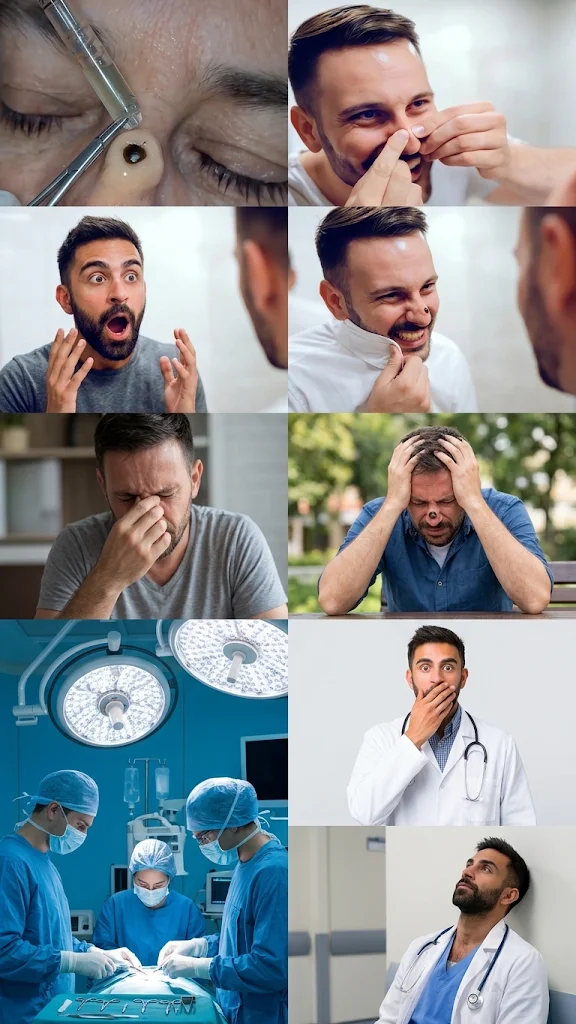
For as long as Joe could remember, his life had been overshadowed by a singular, bizarre feature on his face. Right in the middle of the bridge of his nose, there existed what initially seemed to be an impossibly large blackhead (image_106.png). In the beginning, years ago, it had been a small, dark spot—hardly noticeable, the kind of imperfection anyone might dismiss. But as the years pressed on, it had grown. It didn’t just expand; it darkened, harden, and became a raised, obsidian-like nodule, a swollen, aberration-like anomaly that seemed entirely out of place on a human face (image_107.png, image_108.png).
To everyone else, it looked like a blackhead of historic proportions. But to Joe, it was a daily torment. In the early days, he would spend hours in front of the bathroom mirror, fingers pressed hard against the bridge of his nose, desperately trying to squeeze the life out of the stubborn lump (image_109.png, image_110.png, image_111.png, image_112.png). He would pinch, press, and use over-the-counter tools, only to be met with searing pain and a completely immovable mass. The skin around it would turn raw and angry, but the dark core remained untouched, nestled deeply and firmly within the cartilage and tissue of his nose.
Over time, the psychological burden of the growth became as painful as the physical. He could see the flash of shock and bewilderment in the eyes of strangers when they first looked at him (image_113.png, image_114.png, image_115.png, image_116.png, image_117.png, image_118.png, image_119.png). Conversations with new acquaintances were always punctuated by their involuntary, brief glances toward the center of his face. He became acutely self-conscious, a prisoner to his own features.
“What happened to your nose?” people would ask, some with genuine concern, others with morbid curiosity.
“Just a stubborn blemish,” he would lie, trying to laugh it off, though inside, he felt a deep, gnawing despair.
As the years marched forward, the “blackhead” transitioned from a cosmetic nuisance to a functional nightmare. Because it protruded so prominently, everyday activities became minefields of pain. When he tried to put on a shirt, the collar would catch on the hard lump, sending a sharp, shocking jolt through his face (image_120.png, image_121.png, image_122.png, image_123.png, image_124.png). The simple act of washing his face, wearing sunglasses, or rubbing his eyes in fatigue would trigger a dull, throbbing ache that would linger for hours (image_125.png, image_126.png, image_127.png, image_128.png, image_129.png, image_130.png).
Joe grew increasingly isolated. The constant pain and the anxiety of being stared at wore down his spirit. He spent his evenings at home, avoiding social gatherings, plagued by the relentless, throbbing discomfort in his nose and the growing fear that whatever was on his face was much more dangerous than a mere skin issue. He was on the edge, desperate and entirely at his limit (image_131.png, image_132.png, image_133.png, image_134.png, image_135.png, image_136.png). He couldn’t go on living like this.
Finally, after another agonizing night of fitful sleep and throbbing pain, Joe decided he had to act. He would go to the hospital. He would beg the doctors to cut it out of him, no matter what it took. He just wanted his life back.
Part II: The Discovery
The morning Joe walked into the clinic, he was filled with a mix of dread and hopeful anticipation. He was ushered into an examination room, where a senior physician, Dr. Harrison, came in to evaluate him.
When Dr. Harrison leaned in and saw the growth, the doctor’s usual professional composure cracked. He gasped, his hand instinctively flying to his mouth (image_137.png, image_138.png, image_139.png, image_140.png, image_141.png, image_142.png, image_143.png, image_144.png). He stared in stunned silence at the large, dark, metallic-looking nodule embedded on the bridge of Joe’s nose.
“How long has this been here?” Dr. Harrison asked, his voice hushed, almost fearful.
“Years,” Joe replied, his voice trembling. “It started small. Everyone thought it was just a giant blackhead. Please… can you just cut it out?”
Dr. Harrison called in two of his colleagues, and together they examined the mass with small tools, a syringe, and an ultrasound. What they saw on the screens and felt beneath the gloved fingers made them deeply uneasy. This was no accumulation of sebum or keratin. It was dense, unusually shaped, and integrated into the surrounding tissue in a way that didn’t make medical sense.
“We need to operate, Joe,” Dr. Harrison said, his tone dead serious. “We’re going to schedule you for surgery immediately. We don’t want to wait on this.”
Within hours, Joe was prepped for the procedure. He was wheeled into the operating room, where the surgical team, clad in blue scrubs and protective masks, moved with urgent, quiet efficiency under the intense glare of the surgical lights (image_145.png, image_146.png, image_147.png, image_148.png, image_149.png, image_150.png). Joe felt a cold shiver of fear as the anesthesia began to take hold, his eyes closing as he surrendered his fate to the surgeons.
But as the surgery began, the atmosphere in the room quickly shifted from routine to tense.
Dr. Harrison made the first precise incision around the dark, hardened cap of the “blackhead.” He expected to find a cyst or perhaps a benign tumor. Instead, as the scalpel worked through the layers of tissue, the blade struck something incredibly hard, completely unlike human bone or cartilage.
“What is that?” the assisting surgeon whispered, leaning closer. “It’s… it’s not tissue.”
Using fine forceps and surgical suction, the team carefully dissected the inflamed area. As they cleared away the overlying dark, dead skin and fibrous tissue, they uncovered something entirely baffling. Nestled deep inside the bridge of Joe’s nose, completely encased in years of scar tissue and cellular debris, was a foreign, metallic fragment.
It was a jagged, dark piece of corroded metal, nearly an inch long, that had somehow become embedded deep within his nasal bridge years, perhaps decades, ago. Over the years, Joe’s body had attempted to wall off the foreign object, wrapping it in layers of dark, hardened keratin, fibrous scar tissue, and natural pigments, creating the illusion of a massive, unstoppable blackhead. The body’s relentless inflammatory response to the trapped metal is what had caused Joe’s constant, agonizing pain and the swelling that had disfigured him for so long.
The room was silent as Dr. Harrison carefully lifted the metallic fragment out and placed it into a metal tray with a heavy clink. The surgeons stared at it, speechless (image_151.png, image_152.png, image_153.png, image_154.png, image_155.png, image_156.png, image_157.png, image_158.png). It was a miracle—and a terror—that Joe had lived with such an object embedded in his face for so long without developing a fatal infection.
Hours later, Joe woke up in the recovery room. His nose was heavily bandaged, and he felt a dull, post-surgical soreness—but for the first time in years, the deep, throbbing, heavy ache that had plagued his every waking hour was entirely gone.
Dr. Harrison walked in, carrying a small, clear specimen jar. Inside was the dark, jagged piece of metal.
“We found the culprit, Joe,” the doctor said, holding up the jar. “It wasn’t a blackhead. It was this. Have you ever been in an accident? A fall, a crash, maybe something from your childhood?”
Joe stared at the piece of metal, a rush of memories flooding back. He remembered a childhood accident—a playground fall onto a pile of scrap metal where he had gotten a bad cut on his nose that had eventually healed on its own. He had no idea a piece had broken off and remained trapped inside him, waiting to become his lifelong tormentor.
He looked at the jar, and then at the doctor, a tear of sheer relief slipping down his cheek. The burden was finally gone.