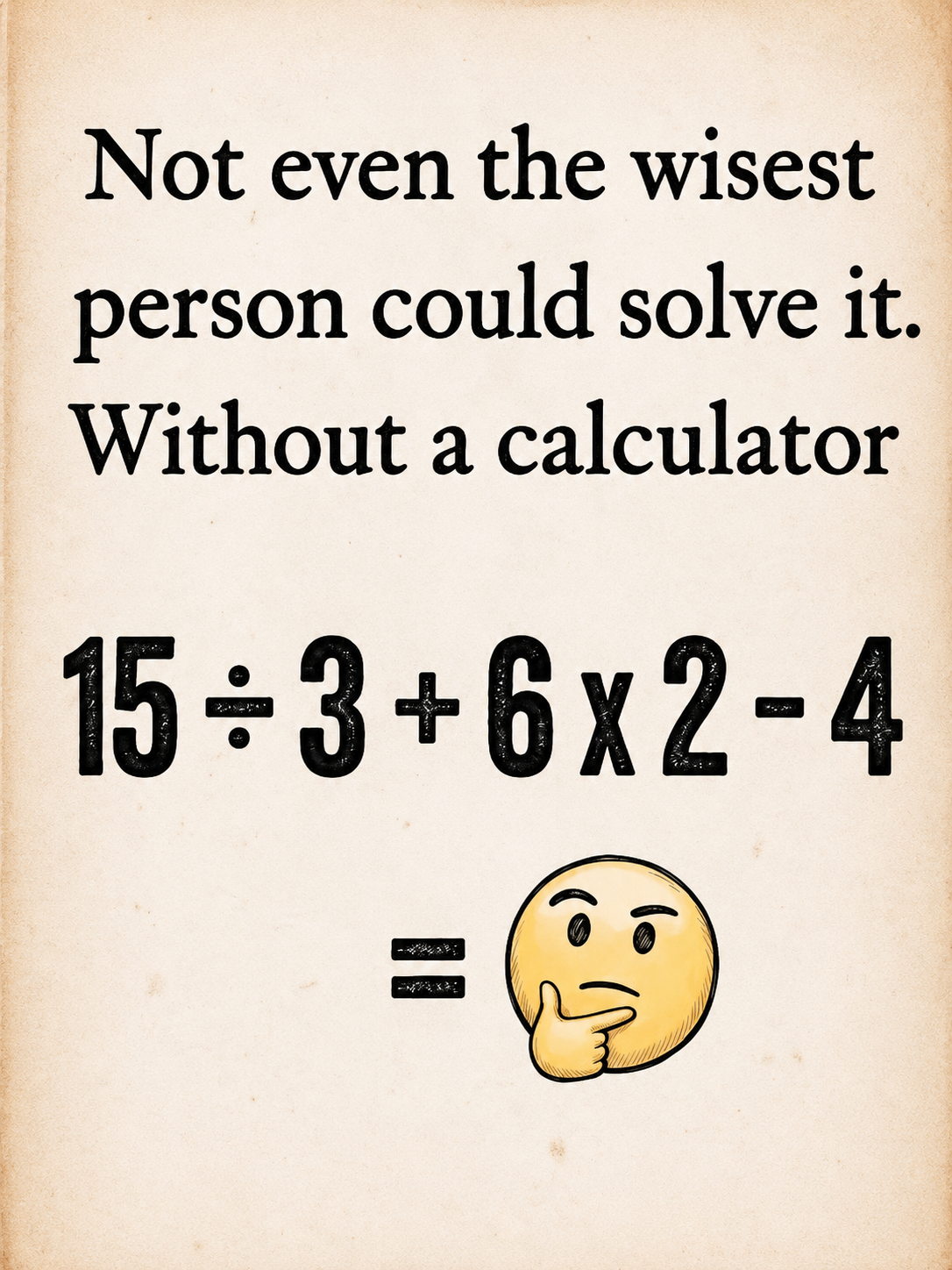
This image presents a simple-looking arithmetic puzzle designed to catch viewers off guard and encourage them to think carefully about the correct order of mathematical operations. At first glance, the problem appears very easy, but the bold statement at the top creates curiosity by suggesting that “Not even the wisest person could solve it. Without a calculator.” This dramatic sentence is intended to challenge the reader’s confidence and persuade them to attempt the calculation themselves. In reality, the expression can be solved easily by following the standard rules of mathematics, making the image more of a brain teaser than an impossible problem.
The design uses a vintage paper-style background with a light beige tone and slightly darker edges that resemble aged parchment. This antique appearance gives the graphic a classic and educational feel rather than a modern digital design. Small faded marks and subtle texture across the background help create the impression of an old book page or historical document, making the image visually interesting while keeping attention focused on the mathematical expression.
At the top of the poster, large black serif text reads, “Not even the wisest person could solve it. Without a calculator.” The font resembles those commonly found in traditional books, adding a scholarly appearance. The words are centered with generous spacing, making them easy to read even from a distance. The statement is intentionally exaggerated. Its purpose is psychological—it encourages people to prove the claim wrong by attempting the puzzle themselves. This type of wording is frequently used on social media because it attracts engagement. People naturally want to demonstrate that they can solve what is presented as a difficult challenge.
The center of the image contains the arithmetic expression:
15 ÷ 3 + 6 × 2 − 4
The numbers and mathematical symbols are much larger than the surrounding text. A bold, distressed font has been used, making the equation the primary focal point of the poster. The rough texture inside the letters gives the impression that the numbers were printed on old paper or slightly worn over time. This styling helps the equation stand out dramatically against the light background.
Below the equation is a large equals sign followed by a thinking-face emoji. Rather than displaying an answer, the designer intentionally leaves the result blank. The emoji, with its hand resting under its chin, represents someone thinking carefully about the problem. It visually reinforces the idea that the viewer should pause and calculate before reaching a conclusion. This small graphical element adds personality and makes the image more engaging, especially for online audiences.
Although many people may attempt to solve the equation from left to right without considering mathematical conventions, the correct approach is to follow the standard order of operations. According to these rules, multiplication and division are performed before addition and subtraction, working from left to right when multiplication and division appear together.
The calculation proceeds as follows:
- First, calculate 15 ÷ 3 = 5
- Next, calculate 6 × 2 = 12
- The expression now becomes 5 + 12 − 4
- Then perform the addition: 5 + 12 = 17
- Finally subtract: 17 − 4 = 13
Therefore, the correct answer is 13.
This puzzle demonstrates an important mathematical principle. Many errors occur because people ignore the proper order of operations and instead solve everything sequentially from left to right. If someone did that incorrectly, they would obtain a different answer. The image serves as a reminder that understanding mathematical rules is more important than simply performing calculations quickly.
From a design perspective, the composition is clean and balanced. There is significant empty space surrounding the text, preventing the layout from feeling crowded. The large typography ensures excellent readability, while the centered alignment creates symmetry throughout the poster. The black text contrasts sharply with the light background, making every element immediately noticeable.
The overall style makes the image highly suitable for sharing on social media platforms such as Facebook, Instagram, and Pinterest. Posts like this often encourage users to comment with their answers, compare results with friends, or debate whether they followed the correct mathematical procedure. Because the puzzle appears simple but often leads to different answers from those unfamiliar with the order of operations, it naturally generates discussion and interaction.
In summary, this image combines attractive vintage-inspired design with a classic arithmetic puzzle to create an engaging visual challenge. The bold headline sparks curiosity, the oversized equation captures attention, and the thinking emoji invites viewers to participate. While the statement claims that even the wisest person cannot solve it without a calculator, the puzzle is actually straightforward once the correct mathematical rules are applied. By carefully following the order of operations, the expression evaluates to 13, making the graphic both entertaining and educational.