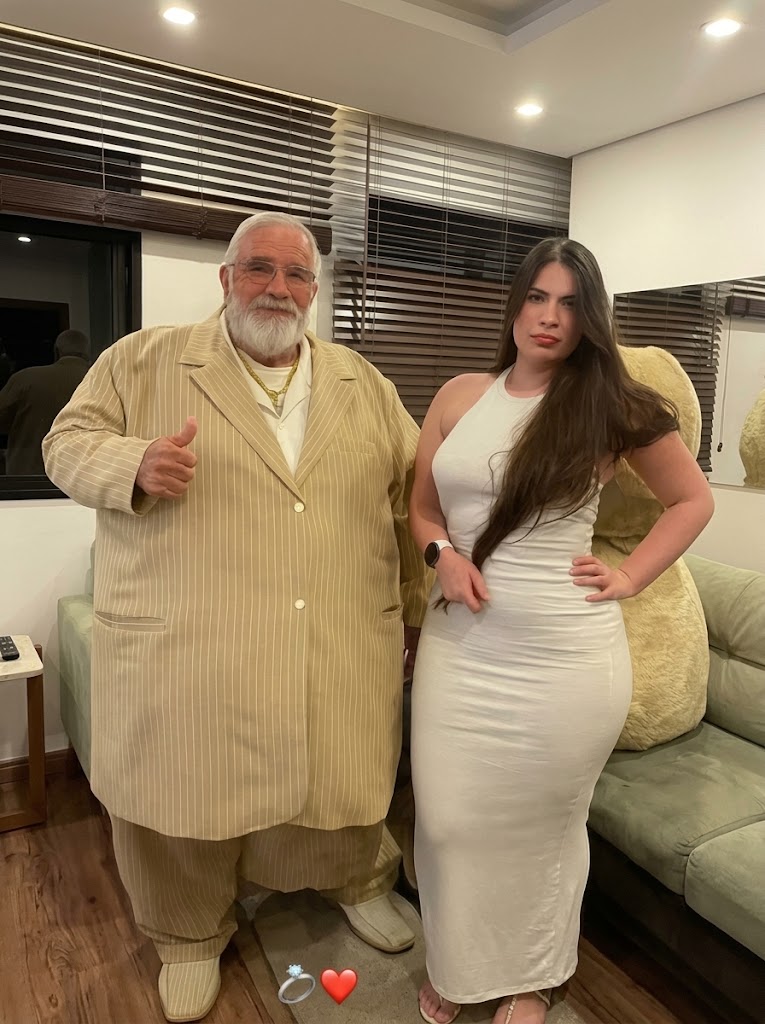

Young Woman Marries a Millionaire—Then Discovers He Doesn’t Own the Fortune Everyone Believed
When 24-year-old Elena Marlowe married Adrian Vale, a wealthy businessman nearly four decades older than her, almost everyone had an opinion.
Some called it a fairy tale.
Others called it a transaction.
The wedding took place at a private estate overlooking the sea, where hundreds of white roses lined the stone walkway and crystal chandeliers illuminated the reception hall. Guests arrived in expensive cars, photographers waited behind velvet barriers, and the evening ended with fireworks reflected across the dark water.
Adrian was 61.
Elena was 24.
He was known throughout the city as a self-made millionaire, a respected businessman who had supposedly built an international property empire from nothing. Newspapers had described him as one of the wealthiest private investors in the region. His name appeared on charity lists, gala invitations, and business magazines.
Elena, by comparison, came from an ordinary family.
She had grown up in a small apartment with her mother, worked part-time during university, and had never lived a life of luxury.
So when she announced her engagement to Adrian, the rumors began immediately.
“She married his money.”
“She’ll be a widow before she’s forty.”
“She must have known exactly what she was doing.”
Elena heard the whispers.
Adrian heard them too.
But neither seemed interested in defending themselves.
“He knows who I am,” Elena once told her closest friend, Sophie. “That’s enough.”
And for the first few months of their marriage, everything seemed perfect.
Adrian gave Elena a beautiful house, a luxury car, expensive jewelry, and access to a lifestyle she had only seen in movies. They traveled frequently, stayed in five-star hotels, and attended parties where politicians, celebrities, and corporate executives gathered.
But Adrian never behaved like a man desperate to impress her.
In private, he was quiet.
He preferred simple meals, old books, long walks, and conversations late at night.
He rarely talked about money.
That was one of the reasons Elena fell in love with him.
She had expected arrogance.
Instead, she found loneliness.
Adrian had been married once before. His first wife had died years earlier after a long illness, leaving him with no children. He had spent most of his life building businesses and avoiding emotional attachments.
Elena was different.
She challenged him.
She made him laugh.
And, most importantly, she never seemed impressed by his wealth.
Or at least, that was what Adrian believed.
Six months into their marriage, Elena began noticing strange things.
The first was the house.
It was supposedly theirs.
But whenever she asked Adrian about the property documents, he changed the subject.
“It’s complicated,” he would say.
She assumed it was simply business paperwork.
Then one afternoon, while Adrian was away on a business trip, Elena received a phone call from the property manager.
“Mrs. Vale?”
“Yes?”
“There seems to be a problem with your access authorization.”
“My what?”
“Your authorization for the estate.”
Elena laughed nervously.
“I live here.”
The man paused.
“Yes, I understand. But according to our records, you’re listed as an occupant, not an owner.”
Elena felt something cold move through her stomach.
“What do you mean?”
“I think you should speak with Mr. Vale.”
The call ended.
Elena immediately phoned Adrian.
He didn’t answer.
She tried again.
Nothing.
That evening, Adrian finally returned.
Elena was waiting for him in the living room.
“What exactly do you own?” she asked.
Adrian stopped in the doorway.
For several seconds, he said nothing.
“What happened?” he finally asked.
“The property manager called me.”
Adrian slowly removed his coat.
“People make mistakes.”
“Are you the owner of this house?”
He looked at her.
“No.”
The answer was so simple that Elena almost laughed.
“What?”
“I don’t personally own the house.”
“Then who does?”
Adrian walked toward the window.
“A company.”
“What company?”
He hesitated.
“Vale Holdings.”
Elena stared at him.
“So you own Vale Holdings.”
Adrian didn’t answer.
“Don’t you?”
“No.”
That was the moment Elena’s entire understanding of her marriage began to collapse.
She had believed Adrian was worth hundreds of millions.
But suddenly she wasn’t sure he owned anything at all.
Over the next several days, Elena began researching his businesses.
She discovered that Adrian’s name appeared everywhere—but usually as chairman, adviser, trustee, or director.
His companies owned buildings.
His companies owned hotels.
His companies owned investment funds.
His companies owned private aircraft.
But Adrian personally owned very little.
Almost everything was held through complicated corporate structures.
At first, Elena thought this was simply how wealthy people protected their assets.
Then she discovered something much more disturbing.
Adrian was not the ultimate owner of many of those companies.
They were controlled by trusts.
And the primary beneficiary of several of those trusts was not Adrian.
It was a person named Clara Vale.
Elena had never heard the name.
She confronted Adrian again.
“Who is Clara?”
His face changed.
For the first time since she had known him, Elena saw genuine fear in his eyes.
“You shouldn’t have looked into that.”
“Who is she?”
“My sister.”
“You told me you were an only child.”
“I told you what I needed you to know.”
The words cut deeper than Elena expected.
“What else have you lied about?”
Adrian sat down.
He looked suddenly much older.
“Everything you heard about my fortune is not entirely true.”
Elena remained standing.
“Then tell me the truth.”
Adrian took a long breath.
“My family was wealthy before I ever made a dollar.”
That was only the beginning.
Adrian explained that his father had built a vast business empire decades earlier. But the family had suffered a devastating financial collapse after a series of failed investments.
To protect what remained, Adrian’s father created a complicated trust structure.
The fortune that the public believed belonged to Adrian was actually controlled by a family trust.
Adrian had been appointed its manager.
He could make investment decisions.
He could live comfortably.
He could direct businesses.
But he did not personally own the fortune.
The true beneficiaries were members of the family, including Clara.
“Why did everyone believe you were a millionaire?” Elena asked.
“Because I controlled the companies.”
“That isn’t the same thing.”
“No.”
“Then why didn’t you tell me?”
Adrian looked at her.
“Because everyone who comes near me eventually asks the same question.”
“What question?”
“How much will I inherit?”
Elena felt insulted.
“You thought I married you for money?”
“I thought everyone did.”
“Even me?”
“You were different.”
“Then why lie?”
Adrian had no answer.
The following morning, Elena packed a suitcase.
She didn’t take the jewelry.
She didn’t take the designer clothes.
She didn’t take the expensive gifts.
She took only the things she had purchased with her own money.
Before leaving, she placed her wedding ring on the kitchen counter.
Adrian found it several hours later.
Underneath it was a note.
“I married a man I believed I knew. I don’t know who you are anymore.”
For the first time in decades, Adrian broke down.
But the story did not end there.
Three weeks later, Elena received a letter from a lawyer.
She almost threw it away.
Instead, she opened it.
The letter contained information that changed everything again.
According to the documents, Elena had been named as a potential beneficiary of a new trust.
The trust had been created shortly before her wedding.
Adrian had transferred no personal fortune to her.
Instead, he had created a fund that would provide Elena with financial independence if the marriage ended.
She called the lawyer immediately.
“Why would he do this?”
The lawyer paused.
“Because Mr. Vale believed you would leave him if you discovered the truth.”
Elena was silent.
“He wanted you to have something that belonged entirely to you,” the lawyer continued.
“But he never told me.”
“No.”
“Why?”
“He said if he told you, you might believe he was buying your loyalty.”
Elena closed her eyes.
Suddenly, the entire situation looked different.
Adrian had lied.
But perhaps his lie had not been about hiding wealth.
Perhaps it had been about hiding insecurity.
Still, Elena wasn’t ready to forgive him.
Months passed.
Elena returned to her old apartment and found work at a nonprofit organization she had volunteered with before meeting Adrian.
For the first time in years, she lived without drivers, assistants, luxury hotels, or private dinners.
And she discovered something unexpected.
She was happier.
Meanwhile, Adrian disappeared from public life.
He stopped attending business events.
He resigned from several boards.
Eventually, rumors began circulating that his empire was collapsing.
Journalists reported that several companies were being reorganized.
Some suggested he had lost his fortune.
Others claimed he had been exposed as a fraud.
But the truth was more complicated.
Adrian had voluntarily surrendered control of most of the businesses.
He wanted to dismantle the image that had followed him for decades.
He no longer wanted to be known as the mysterious millionaire.
He wanted to become simply Adrian.
One year after their separation, Elena received a handwritten letter.
There was no expensive envelope.
No lawyer.
No gift.
Just three pages of paper.
Adrian wrote that he did not expect her to return.
He apologized for lying.
He admitted that his greatest fear had never been losing money.
It had been discovering that without money, nobody would love him.
“I spent my entire life believing wealth protected me,” he wrote. “Eventually I realized it only made it harder to know who was standing beside me for the right reasons.”
Elena read the letter twice.
Then she put it away.
She did not call him.
Not yet.
Several months later, she was invited to a charity event.
When she arrived, she saw Adrian standing alone near the back of the room.
He wasn’t surrounded by executives.
He wasn’t wearing an expensive watch.
He wasn’t being photographed.
He looked ordinary.
Elena walked toward him.
“Hello,” she said.
Adrian turned.
For a moment, neither spoke.
“I wasn’t sure you’d come,” he said.
“I almost didn’t.”
“I understand.”
She looked at him carefully.
“Are you still a millionaire?”
Adrian smiled faintly.
“I honestly don’t know.”
That answer made Elena laugh for the first time in months.
“What happened to all of it?”
“Some of it was never mine.”
“And the rest?”
“I gave much of it away.”
“To charity?”
“To people who actually needed it.”
Elena nodded.
There was a long silence.
Then Adrian asked the question he had been afraid to ask.
“Do you regret marrying me?”
Elena looked at him.
“I regret that you didn’t trust me enough to tell me the truth.”
He lowered his eyes.
“But I don’t regret meeting you.”
Adrian looked up.
Neither of them knew what would happen next.
They did not immediately reconcile.
There was no dramatic kiss.
No grand declaration.
No fairy-tale ending.
Instead, they began talking again.
Slowly.
Honestly.
Without lawyers.
Without contracts.
Without discussions about inheritance.
Over the following months, Elena learned more about the real Adrian than she had during their marriage.
And Adrian learned something even more important.
Love could not be secured by money.
It could not be protected by trusts.
It could not be guaranteed by expensive gifts.
If anything, wealth sometimes made genuine love more difficult to recognize.
Eventually, Elena agreed to give their relationship another chance.
But this time, she established one condition.
“No more secrets.”
Adrian agreed.
And he kept his promise.
Years later, people still remembered Elena as the young woman who married a millionaire.
But that wasn’t the story Elena told.
Whenever someone asked about her unusual marriage, she simply smiled.
“He wasn’t really a millionaire,” she would say.
“He was a man who spent his whole life pretending he had everything.”
“And what happened?”
“He finally learned that having everything isn’t the same as having someone.”
That was the lesson Elena carried with her.
The world had judged her before it knew her.
People had assumed she wanted Adrian’s fortune.
They had assumed she was trading youth for luxury.
They had assumed the marriage was built on money.
But the truth was far more complicated.
Elena had married a lonely man who happened to live inside a wealthy man’s world.
Adrian had married a young woman he feared might eventually discover the truth and leave him.
Both had entered the marriage carrying assumptions.
Both had hidden parts of themselves.
And both eventually learned that the most valuable thing in their lives was something no trust, corporation, mansion, or bank account could guarantee.
Trust.
Because when money disappears, appearances change, and the world stops applauding, the only question that remains is brutally simple:
Who stays?
For Elena and Adrian, finding the answer took years.
And perhaps that was worth more than the fortune everyone once believed they owned.